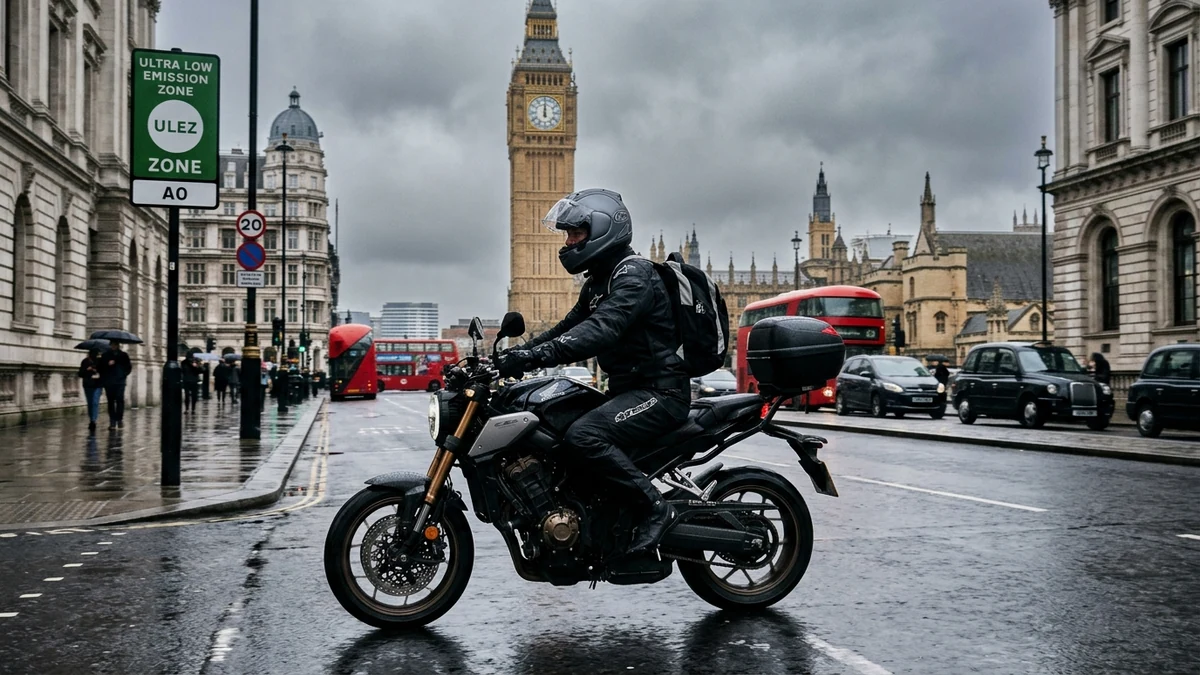
⚡ 1. The TfL Euro 3 NOx Standard (0.15 g/km) Explained
London’s Ultra Low Emission Zone (ULEZ) operates under strict emissions thresholds defined by Transport for London (TfL). While petrol cars must meet Euro 4 and diesels must meet Euro 6, motorcycles, mopeds, motorised tricycles, and quadricycles (L-category vehicles) must meet the Euro 3 standard.
Crucially, Euro 3 for motorcycles is judged strictly on nitrogen oxides (NOx) emissions, which must not exceed 0.15 grams per kilometre (0.15 g/km):
- CO2 is Irrelevant: Unlike car road tax (VED), carbon dioxide output has zero impact on ULEZ compliance. A 1800cc heavyweight cruiser producing low NOx complies, whereas a small two-stroke commuter emitting high NOx does not.
- Fuel Consumption & Engine Size Do Not Matter: A 1200cc modern motorcycle achieving 45 mpg is compliant if its NOx is under 0.15 g/km, while a 1998 125cc commuter achieving 100 mpg will face the £12.50 daily fee if its tailpipe NOx exceeds the threshold.
- The 1 July 2007 Milestone: Euro 3 became mandatory for all new motorcycles registered in the UK on 1 July 2007. Consequently, TfL assumes any motorcycle registered on or after this date is automatically compliant.
Never rely on registration year alone to decide whether a used motorcycle is compliant. Many pre-2007 machines (including Honda CBR600F4i from 2001, BMW R1150GS from 2002, and Triumph Bonneville EFI from 2006) were engineered well below 0.15 g/km NOx years before Euro 3 became statutory. Conversely, late-registered pre-Euro 3 stock sold in late 2007 can be wrongly assumed compliant. Always check the physical NOx evidence.
🔍 2. Checking Your Registration & Uncovering Database Errors
Before travelling into Greater London, check your vehicle registration number on the official TfL Vehicle Checker. However, riders must understand how TfL populates its database.
How the TfL Database Works
TfL cross-references the DVLA vehicle database to determine whether a motorcycle incurs the daily charge. When a vehicle was originally registered with the DVLA, the vehicle manufacturer supplied type-approval data:
- If the V5C logbook contains an explicit Euro status (e.g. "Euro 3") or states a NOx figure of 0.15 g/km or lower in section V.5 (Exhaust emissions: NOx), TfL marks the bike as compliant.
- If field V.5 on the V5C was left blank by the supplying dealer (which was extremely common for motorcycles registered prior to 2007), the DVLA record contains no emissions data.
- When TfL’s automated system encounters a pre-July 2007 registration with a blank V.5 field, it defaults to non-compliant and issues a daily charge, even if the motorcycle model is technically cleaner than Euro 3.
Grab your V5C registration certificate. Turn to page 2, Section 4 ("Vehicle details"), sub-section V ("Exhaust emissions"). Look at field V.5 (NOx g/km). If a number is printed and it is 0.150 or lower, you have official government proof of compliance that TfL must honour.
📄 3. The CoC Route & Pre-2007 Compliant Motorcycles
If your motorcycle was registered before 1 July 2007 and the TfL checker states that you must pay the £12.50 daily charge, do not panic or rush to sell the bike. You can likely get it declared compliant permanently for free using a Certificate of Conformity (CoC).
What is a Certificate of Conformity?
A Certificate of Conformity is an official manufacturer declaration stating that an individual vehicle (identified by its unique 17-digit VIN/frame number) was built in compliance with European type-approval standards. It includes exact laboratory emissions measurements taken when that chassis family was certified.
The 3-Step Compliance Decision Flow
Check Your V5C Logbook (Field V.5)
Check page 2 of your V5C registration document under Section 4, field V.5 (NOx). If a figure of 0.150 g/km or less is recorded, upload a scan of your V5C to TfL's vehicle compliance registration portal for direct exemption.
If V.5 is Blank: Request a Manufacturer CoC
If field V.5 is unpopulated, contact the manufacturer’s UK homologation or customer relations department (Honda UK, Yamaha Motor UK, Triumph Motorcycles, BMW Motorrad, Suzuki GB, Kawasaki UK, etc.). Request a Certificate of Conformity for your VIN. Check row 46.1 or 48 for NOx ≤ 0.150 g/km, then submit the certificate to TfL.
If CoC Unavailable or Over 0.15 g/km: Book an Approved Dyno Test
If the manufacturer cannot provide documentation (e.g. Japanese domestic grey import, defunct marque, or pre-homologation model), book a tailpipe emissions assessment at an approved motorcycle chassis dynamometer test centre (~£175–£200) to measure real-world urban drive cycle NOx.
Popular Pre-2007 Motorcycles Known to Pass
Many riders assume that all pre-2007 bikes face the daily charge. In reality, thousands of early fuel-injected and catalytic-converter models built between 2000 and 2006 emit well below 0.15 g/km NOx and have successfully achieved permanent TfL exemption:
| Make & Model | Model Years | Fuel System & Exhaust | Verified Route | Technical Notes |
|---|---|---|---|---|
| Honda CBR600F4i | 2001–2006 | PGM-FI Electronic Injection + Cat | CoC or Dyno Test | Emits ~0.08–0.11 g/km NOx. Honda UK CoC confirms Euro 3 NOx compliance; readily passes dyno test. |
| Honda CB600F Hornet | 2003–2006 | Keihin Carburettors (2003–06) | Dyno Test | Late carburetted models emit ~0.12–0.14 g/km NOx on rolling-road dyno with clean carbs and fresh spark plugs. 2007+ EFI passes via CoC. |
| Honda VFR800 VTEC | 2002–2006 | PGM-FI + Dual Catalysts + Lambda | CoC Exemption | Euro 2/3 transition model. Honda homologation certificate confirms NOx below 0.12 g/km for immediate free exemption. |
| BMW R1150GS / R1150RT | 2003–2005 (Twin-Spark) | Bosch Motronic EFI + Closed-Loop Cat | CoC or Dyno Test | Twin-spark models run exceptionally clean (NOx ~0.06–0.09 g/km). CoC from BMW Motorrad UK confirms compliance. Single-spark models (1999–2002) routinely pass dyno. |
| BMW R1200GS | 2004–2006 | BMS-K EFI + 3-way Catalytic Converter | CoC Exemption | Type-approved well below Euro 3 statutory NOx limits from launch. BMW CoC yields instant TfL exemption. |
| BMW F650GS (Single) | 2000–2007 | BMS-C EFI + Catalytic Converter | CoC or Dyno Test | Fuel-injected single-cylinder engines emit very low mass NOx on rolling-road test cycles. |
| Triumph Bonneville 865 | 2006–2007 | Late Pre-Euro 3 / Keihin EFI Transition | CoC Exemption | Late 2006 and early 2007 Hinckley twin models carry factory homologation under 0.15 g/km NOx. |
| Triumph Speed Triple 1050 | 2005–2006 | Keihin EFI + Under-Seat Catalyser | CoC Exemption | 1050cc engine generation was engineered to Euro 3 standards from launch. CoC provides immediate free exemption. |
| Suzuki SV650 (K3–K6) | 2003–2006 | SDTV Dual Throttle Valve EFI | CoC or Dyno Test | Fuel-injected K3+ models routinely record <0.15 g/km NOx; Suzuki GB provides CoC on request. |
| Yamaha FZS600 / FZ6 Fazer | 2004–2006 | R6-derived EFI + Under-Seat Cat | CoC Exemption | Second-generation FZ6 (2004+) certified to Euro 3 limits; Yamaha CoC yields direct TfL pass. |
If you have questions about how to request a Certificate of Conformity or how type approvals interact with insurance and ownership, browse our Motorcycle FAQs for detailed guidance.
🔬 4. Approved Rolling-Road NOx Test Facilities & Pre-Test Checklist
What if your motorcycle is an older carburetted machine, a Japanese domestic market (JDM) grey import without a European CoC, or the manufacturer no longer exists? You can still achieve full, permanent ULEZ compliance by booking an emissions test at a TfL-approved motorcycle test facility.
How the Real-World Dyno Test Works
Unlike a standard annual MOT test (which does not measure motorcycle tailpipe NOx emissions), approved test centres operate a calibrated chassis dynamometer (rolling road) coupled to an exhaust gas laboratory:
- The motorcycle is strapped to the rolling road and driven through a simulated urban drive cycle representative of the UNECE Regulation 40 test cycle.
- Exhaust gases are captured and analysed in real time using specialised chemiluminescence or NDIR sensors to measure total NOx mass emitted over the driving cycle.
- If the average NOx emitted is 0.15 g/km or less, the facility issues a pass certificate and transmits the result directly to Transport for London.
- TfL then updates its ANPR camera database within a few business days, granting the motorcycle lifetime ULEZ exemption.
Approved Motorcycle Test Centres
TfL maintains a recognised list of certified motorcycle emissions testing centres, including:
- Riverbank Motorcycles: Located in Bow, East London (Unit 12, River Bank Business Park, E3 2NT). Specialises in pre-2007 Japanese, Italian, and British roadsters.
- ULEZ Testing UK (Bikers World): Operating in Colindale / North London. Equipped with official chassis dynamometer test benches for motorcycle emissions.
- The Test Centre: Located in Deptford, South East London. Certified for L-category emissions assessments.
An approved motorcycle emissions test costs £175 to £200, and retests incur additional fees. Follow this pre-test preparation checklist to ensure your motorcycle passes on its first run:
- Fresh, Correctly Gapped Spark Plugs: Worn electrodes cause microscopic misfires that dramatically spike volatile unburnt hydrocarbons and nitrogen oxides. Fit fresh OEM-spec plugs gapped to manufacturer specification.
- Clean OEM Paper Air Filter: Avoid heavily oiled foam or cotton-gauze aftermarket filters immediately prior to testing; excess oil vapor sucked into the intake can foul optical exhaust sensors and richen the combustion mix.
- Fuel System Clean & Super Unleaded: Run through a full tank of fresh 97/99 RON super unleaded treated with a quality fuel injector or carburettor cleaner to remove varnish and ensure crisp spray atomisation.
- Exhaust System Seal Integrity: Inspect exhaust headers, collector boxes, and silencer slip-on joints for pinholes, rust perforations, or blowing copper crush gaskets. Fresh air drawn into the exhaust stream dilutes lambda readings and causes false lean/fail results.
- Thorough Engine Warmup: Ride for at least 20 to 30 minutes before arriving at the test centre. Catalytic converters require core temperatures of 400°C to 600°C to achieve optimum chemical conversion of nitrogen oxides. Never present a bike with a cold exhaust.
📍 5. Operating Hours, The M25 Boundary & The £12.50 Tariff
If your motorcycle does not meet Euro 3 NOx standards and has not been registered as exempt, you must pay the daily charge whenever you ride within the zone.
Hours of Operation
- 24 Hours a Day, 365 Days a Year: ULEZ operates continuously, seven days a week, 365 days a year—including bank holidays and weekends. The only exception is Christmas Day (25 December), when charges are suspended until 00:01 on 26 December.
- The Midnight-to-Midnight Rule: The charge operates on a calendar day basis (00:00 to 23:59). If you ride into the zone at 23:30 on Friday and ride home at 00:30 on Saturday morning, you have ridden across two distinct charging days and must pay 2 × £12.50 = £25.00.
The Greater London Boundary & The M25 Ring Road
Following the August 2023 expansion, the ULEZ boundary encompasses all 32 London boroughs plus the City of London, stretching out toward the perimeter ring road in outer boroughs like Bromley, Croydon, Enfield, Havering, and Hillingdon. Over 3,400 automatic number plate recognition (ANPR) cameras enforce the boundary.
A widespread misconception among touring and motorway riders is that the M25 ring road itself is within the charging zone. The M25 motorway is NOT within the ULEZ boundary. You can ride the entire 117-mile circuit of the M25 completely charge-free. You only enter the zone if you take an exit slip road into an administrative London borough (prominently signposted with large green 'ULEZ' advance warning road signs). Roundabouts at key motorway intersections (e.g. J14 for Heathrow, J28 for Brentwood/Romford, J6 for Godstone) have clearly demarcated camera boundaries.
Riders often confuse Greater London’s ULEZ (£12.50/day emissions charge) with central London’s separate Congestion Charge (£15/day). Under TfL regulations, all two-wheeled motorcycles and mopeds are 100% exempt from the London Congestion Charge, with no registration, paperwork, or daily fee required. Even if your motorcycle incurs the ULEZ charge due to older emissions, you never pay the Congestion Charge when riding in central London.
Payment Deadlines & Penalties
- Payment Window: You can pay in advance, on the day of travel, or up to midnight on the third day following the journey.
- TfL Auto Pay: Regular London riders should set up TfL Auto Pay. Setting up and adding vehicles to Auto Pay is 100% free of charge (TfL permanently abolished the former £10 annual registration fee). The system automatically records your journeys via ANPR cameras and bills your payment card monthly with zero administrative surcharge—you only pay for the actual journeys recorded, eliminating the risk of forgetting to pay within three days and receiving a £180 PCN.
- Penalty Charge Notices (PCNs): If you fail to pay within the three-day window, TfL issues a Penalty Charge Notice of £180 (discounted to £90 if paid within 14 days).
🌍 6. Foreign & Non-UK Registered Motorcycles: The EPC plc Step
Visiting riders and European motorcycle tourists frequently face unexpected penalties when riding in London. This happens because Transport for London (TfL) has no automated access to non-UK vehicle licensing databases (such as those in France, Germany, Ireland, the Netherlands, Spain, or Poland).
The Automated ANPR Penalty Trap
When a motorcycle bearing non-UK number plates passes an ANPR camera in the London ULEZ, TfL’s computer cannot query the motorcycle’s type-approval records or Euro standard. By default, the automated system classifies all unregistered foreign motorcycles as non-compliant and issues a £180 Penalty Charge Notice, even if the motorcycle is a 2024 model fully compliant with Euro 5 or Euro 5+ emissions standards.
The Mandatory EPC plc Registration Process
Transport for London contracts international vehicle compliance verification and cross-border fine administration to Euro Parking Collection plc (EPC plc). To ride legally without incurring automated penalties, visiting riders must pre-register their motorcycle:
Create an Account on EPC plc
Visit the official Euro Parking Collection plc TfL registration portal. Register an account and enter your motorcycle's make, model, registration plate number, and country of registration.
Upload Required Documentary Evidence
Upload a clear digital photograph or scan of your official national vehicle registration certificate (V5C equivalent, such as Germany's Zulassungsbescheinigung Teil I, France's Certificat d'immatriculation / Carte Grise, or Ireland's Vehicle Registration Certificate). Ensure the document clearly displays the vehicle's Euro status (Euro 3, 4, 5, or 5+) or an explicit NOx measurement of ≤ 0.150 g/km. If the registration document omits emissions data, you must attach the manufacturer's Certificate of Conformity (CoC).
Allow 10 to 14 Working Days for Manual Verification
EPC case officers manually review submitted foreign registration documents. Validation typically takes 10 to 14 working days before the vehicle is added to TfL’s live ANPR whitelist. Do not enter the ULEZ until you have received formal email confirmation that your vehicle has been validated as compliant.
If you are riding from Dover, Folkestone (Eurotunnel), or Harwich and your route takes you toward Wales, the Midlands, or the North, plan your route around the M25 ring road. Remember: riding on the M25 motorway itself is 100% exempt from ULEZ charges. Avoid accidentally exiting into inner Greater London boroughs unless your motorcycle has been formally verified on EPC plc.
🇬🇧 7. Regional UK Clean Air Zones: Birmingham, Bristol, Bath & Scotland
A common source of anxiety for UK motorcyclists is whether regional Clean Air Zones (CAZs) in English cities and Low Emission Zones (LEZs) in Scotland penalise two-wheelers. The reality is remarkably reassuring.
The UK Clean Air Zone Framework
Under the UK Government’s Clean Air Zone Framework, zones are categorized into four classes (Class A, B, C, and D). Motorcycles are completely excluded from classes A, B, and C by statutory definition. Even in Class D zones, local authorities have virtually all chosen to exempt motorcycles.
| Zone Location | Zone Classification | Motorcycle Daily Charge | Exemption Rule / Note |
|---|---|---|---|
| London ULEZ | TfL Specific Standard | £12.50 | Chargeable if tailpipe NOx exceeds 0.15 g/km (Euro 3). |
| Birmingham CAZ | Category D | £0.00 (Exempt) | Birmingham explicitly exempts all motorcycles and mopeds from charges. |
| Bristol CAZ | Category D | £0.00 (Exempt) | Bristol charges older private cars and vans, but all two-wheelers are 100% exempt. |
| Bath CAZ | Category C | £0.00 (Exempt) | Does not charge private cars or motorcycles. |
| Sheffield CAZ | Category C | £0.00 (Exempt) | Charges commercial HGVs and LGVs only; motorcycles exempt. |
| Newcastle & Gateshead | Category C | £0.00 (Exempt) | Motorcycles, mopeds, and private vehicles incur zero charges. |
| Scotland LEZs (Glasgow, Edinburgh, Dundee, Aberdeen) |
Scottish National Standard | £0.00 (Exempt) | Under Scottish LEZ regulations, motorcycles and mopeds are universally exempt by law. |
| Oxford ZEZ (Pilot City Centre Zone) |
Zero Emission Zone | £2.00 to £10.00 | Pilot area charges all combustion vehicles unless zero-emission electric. Daily fee depends on emissions. |
As the table demonstrates, London remains the only major UK metropolitan area where standard motorcycles face routine daily emissions charges. Outside London, with the minor exception of a small pilot street network in Oxford, motorcyclists can tour and commute across England, Wales, and Scotland without fear of municipal clean air tariffs.
🏛️ 8. The 40-Year Rolling Historic Exemption & A2 Alternatives
If you own or are considering buying a classic or vintage motorcycle, you may qualify for automatic, permanent exemption from London ULEZ charges under national statutory rules.
The 40-Year Rolling Historic Vehicle Rule
Transport for London mirrors the national DVLA exemption for historic vehicles. To qualify:
- Your motorcycle must have been built or first registered more than 40 years ago. For the 2026/27 tax year, vehicles manufactured before 1 January 1986 are eligible.
- The 1 April Tax Window: The DVLA’s rolling 40-year exemption does not take effect on the exact monthly anniversary of your motorcycle’s assembly date. Reclassifications roll into law on 1 April each year (the start of the financial tax year). If your motorcycle was built in July 1986, it does not become eligible in July 2026; you must wait until 1 April 2027 to submit your V112 declaration to the DVLA.
- You must apply to the DVLA to have the vehicle’s tax class officially changed on the V5C logbook to Historic Vehicle.
- Once registered in the Historic Vehicle tax class, the motorcycle is 100% exempt from the ULEZ charge, regardless of its tailpipe emissions, two-stroke oil smoke, or carburettor configuration.
- The historic vehicle exemption applies equally to UK residents and overseas visitors riding classic machinery.
Merely being 40 years old is not enough; the V5C must explicitly declare the tax class as "Historic Vehicle". If your 1983 motorcycle is still taxed under the standard "Bicycle" tax class on DVLA records, TfL’s ANPR cameras will bill you £12.50 per day until you complete the V112 declaration at a Post Office to reclassify the machine.
Considering Downsizing to a Clean Urban Commuter?
If your current motorcycle is non-compliant and not eligible for historic exemption, many riders choose to switch to modern, ultra-clean sub-500cc machinery (such as the Royal Enfield Hunter 350, Honda CB500F, or Triumph Speed 400). If you are exploring this route, use our Motorcycle Licence & A2 Category Calculator to check category entitlements, age requirements, and restriction thresholds.
💰 9. Commuter Economics: Paying the Daily Tariff vs Upgrading
For daily London commuters, riding a non-compliant motorcycle creates severe ongoing financial penalties. Understanding the long-term mathematical reality helps you make an informed decision between testing, retrofitting, or replacing your machine.
The Real-World Financial Math
- 5-Day Working Week Commute: 5 days × £12.50 = £62.50 per week. Over 46 working weeks per year, this totals £2,875.00 per year in pure municipal charges.
- 3-Day Hybrid Schedule: 3 days × £12.50 = £37.50 per week. Over 46 weeks, this totals £1,725.00 per year.
- The Dyno Test Payback Period: If your pre-2007 motorcycle passes the £195 approved emissions test at Riverbank Motorcycles or ULEZ Testing UK, the test pays for itself in less than four weeks of standard commuting.
- Replacing the Bike: If your motorcycle cannot pass Euro 3 NOx levels, redirecting £2,875 per year toward financing or purchasing a compliant Euro 3, Euro 4, or Euro 5 middleweight commuter (e.g. Honda CB500F, Royal Enfield Meteor 350, or Triumph Speed 400) represents an immediate net saving.
Calculate the combined impact of ULEZ charges, UK road tax (VED), fuel economy, and insurance quotes across multiple motorcycle candidates using our interactive Motorcycle Running Costs Estimator.
Sources & further reading
Transport for London & compliance portals
- Transport for London: Motorcycles, mopeds and more ULEZ emissions standards
- Transport for London: Official vehicle compliance checker
- Transport for London: Register an exempt vehicle / correct compliance status
- Transport for London: Auto Pay account setup
- London Assembly: Correcting ULEZ records with manufacturer Certificate of Conformity evidence
- Euro Parking Collection plc (EPC): Non-UK vehicle ULEZ pre-registration portal
Regional Clean Air Zones & Scottish LEZs
- GOV.UK: Driving in a Clean Air Zone national framework
- Birmingham City Council: Clean Air Zone charges and exemptions
- Bristol City Council: Clean Air Zone charges and vehicle classes
- Transport Scotland: Low Emission Zones national vehicle exemptions
- Oxfordshire County Council: Oxford Zero Emission Zone (ZEZ) pilot rules
Certified testing facilities & historic exemption
Specifications, prices and rules can change. Check the linked primary source before making a purchase or riding decision. Our editorial standards.