Choosing a motorcycle means bringing several decisions together. The bike needs to suit your licence, your budget and the way you actually ride. Bike Riders Junctions connects those decisions in one independent UK toolkit: check your licence route, estimate the recurring costs, then compare seat height and published weight before arranging a viewing.
Start with the question you need to answer today. A commuter might want to compare fuel costs and London ULEZ charges. A new rider might need to understand A2 restrictions. Someone returning to riding may want a manageable cruiser. Each tool shows its assumptions and links to further reading, so you can turn an initial result into a better shortlist.
Check your motorcycle licence and A2 eligibility
The UK motorcycle licence calculator combines your age, CBT status and time holding a full A2 licence with the motorcycle’s capacity, power and approved mass. It identifies an indicative standard Great Britain test route and checks the machine’s A1 and A2 limits. Having a possible test route does not mean you already have permission to ride that bike.
A2 checks need more than a “47 bhp” label. The limit is 35 kW, the power-to-weight ratio must not exceed 0.2 kW/kg, and the original motorcycle must not have produced more than twice its restricted power. Enter the exact model’s documented figures, rather than adding rider or luggage weight to make a result pass. Our A2 licence guide explains the calculation.
For example, a 60 kW motorcycle restricted to 25 kW fails the original-power condition, even though 60 kW is below the often-quoted 70 kW ceiling. Confirm restriction paperwork and test-bike suitability with your training school. The calculator covers standard GB routes; use nidirect for Northern Ireland and official guidance for older entitlements or exceptions.
Build a realistic motorcycle running-cost budget
Purchase price is only the beginning. Open the motorcycle running-cost calculator with your expected annual mileage, fuel economy and local petrol price. Add an actual motorcycle insurance quote and an allowance for maintenance, MOT tests and motorcycle tyres. The result separates the major costs and shows annual, monthly and per-mile estimates, making different mileage scenarios easier to compare.
Use UK imperial mpg when entering petrol consumption. For an electric motorcycle, switch the power source and enter miles per kWh and your electricity tariff. Public charging and home charging may cost different amounts, so choose a realistic blended figure for your own routine. The example inputs are editable planning values, not live fuel prices or personalised insurance offers.
The estimator applies the 2026/27 DVLA motorcycle tax bands for a single annual payment. These are £27 up to 150cc, £59 for 151–400cc, £90 for 401–600cc and £125 above 600cc. Zero-emission motorcycles are £27 unless a relevant exemption applies. Instalment totals can differ; check the payment method before budgeting.
For London journeys, select your confirmed ULEZ result or leave compliance unknown to see a cost range. TfL’s motorcycle standard is Euro 3 for nitrogen oxides, with a £12.50 daily charge where applicable. Registration year alone is not a reliable verdict. Use the official vehicle checker before travelling, and check local rules separately for other clean air zones.
Treat the output as a recurring riding budget. Finance, depreciation, parking, breakdown cover, new gear and unexpected repairs are not separate calculated categories. Keep an additional allowance for them, or include relevant spending in your upkeep input without counting it twice. Comparing two bikes works best when you keep mileage and assumptions consistent and change only the figures that genuinely differ.
Compare seat height, weight and riding posture
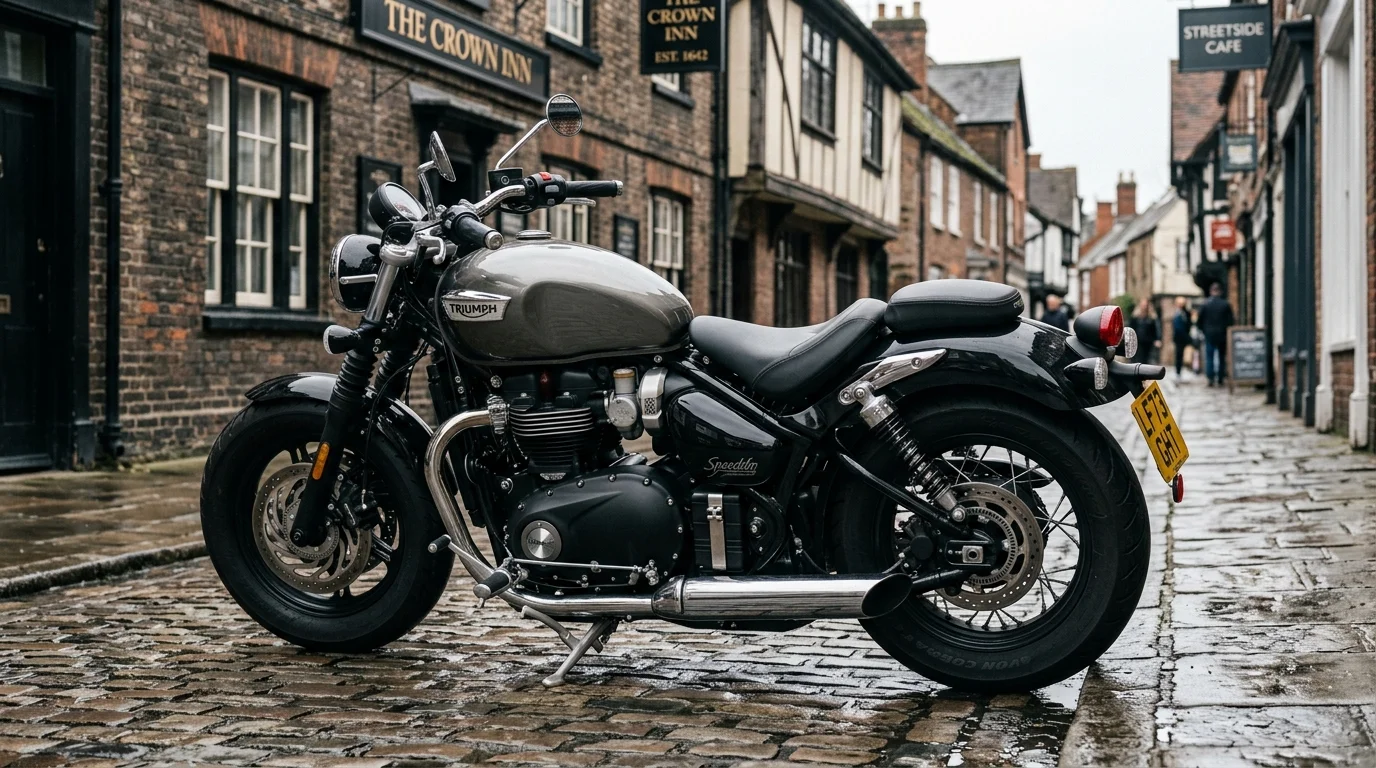
The motorcycle seat-height fit checker helps you compare selected Harley-Davidson, Triumph, Royal Enfield and commuter models. Enter your inseam to see its numerical difference from each published seat height, alongside the bike’s listed mass and a description of its riding posture. Source links and model notes help you check which specification you are comparing.
A low seat does not automatically make a heavy cruiser easy to handle. Seat width, suspension sag, boot soles, handlebar reach and foot-control position all affect the experience. An inseam comparison cannot predict whether both feet will sit flat on the ground. Use it to decide which motorcycles to try, then assess the actual machine with a dealer or instructor.
For a first cruiser, consider parking, walking the bike and reaching the controls as carefully as motorway comfort. Compare the same model year and market specification: a regional reference is not proof of the UK specification. Our first cruiser buying guide provides a practical framework for that conversation, without assigning a misleading universal fit score.
Choose motorcycle helmets, clothing and security with evidence
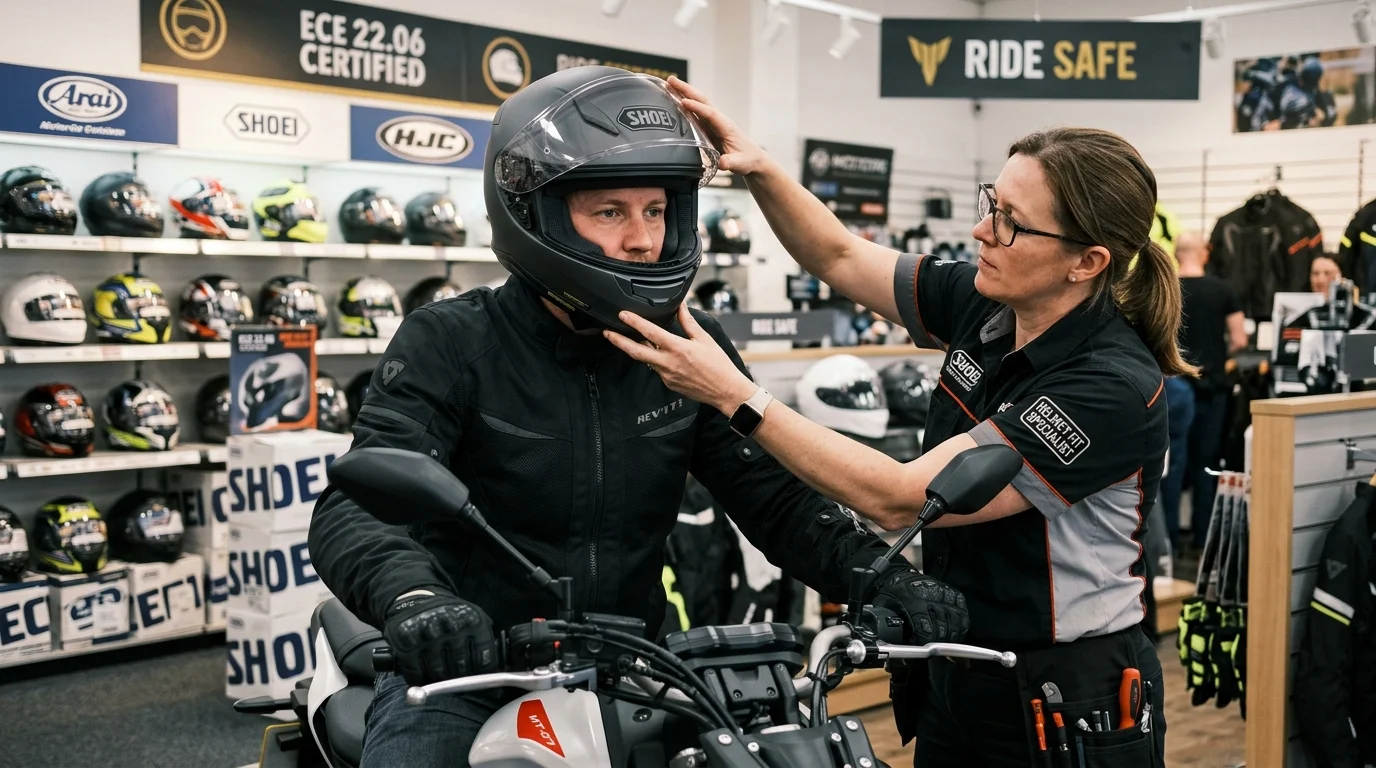
Leave room in the budget for equipment before deciding what you can spend on the bike. When comparing motorcycle helmets, start with fit, comfort and the exact model’s approval information. Look up its SHARP rating where available, rather than assuming every helmet from a brand performs alike. Our helmet safety guide explains how ratings and fit inform different parts of the decision.
For motorcycle clothing, inspect the garment’s certification and the supplied armour separately. A motorcycle jacket’s appearance does not tell you its protective performance. Use the protective clothing guide to frame questions about standards, fit, coverage and weather protection. Compare motorcycle boots and motorcycle gloves for the conditions you expect to ride in, and try the full outfit in a riding position.
Heated motorcycle gloves may be useful on a cold commute, but compare the particular product’s power supply, fit and documented protection before buying. For locks, verify the exact product and current category or grade in the Sold Secure directory, then check your insurer’s requirements. The motorcycle security guide connects these checks with practical storage considerations.
Our buying guides are research-led and link to their sources. They do not claim hands-on testing that has not happened. Read the affiliate disclosure for how commercial links are handled, and compare retailer specifications, returns and current prices yourself before placing an order.
Turn the results into a useful shortlist
For a daily commute, run the cost tool with your expected working-week mileage and zone journeys, then add leisure miles. For a heritage or cruiser purchase, compare fit and weight before letting the badge decide. The motorcycle brand hubs connect manufacturer references with the tools and buying guides, helping you move between research and a specific decision.
Once the essentials are clear, explore the UK motorcycle route directory. It offers starting points in England, Wales, Scotland and Northern Ireland, with external maps and local sources. These are planning references, not live road-condition reports or verified turn-by-turn tracks. Check weather, closures, fuel stops and your available daylight before setting out.
Motorcycle questions, answered.
Clear, official answers to the most common questions UK motorcycle riders search for—from CBT and A2 licensing rules to insurance, helmet safety, and cross-channel trips.
How do I get a motorcycle licence in the UK?
How do I get a motorcycle licence in the UK?
To get a full motorcycle licence in Great Britain (GB), follow these sequential DVSA steps:
- Check your licence entitlement: Apply for a UK provisional driving licence with Category A entitlement (or confirm existing provisional entitlement on your full car licence).
- Complete Compulsory Basic Training (CBT): Complete a 1-day CBT course with an approved training school (ATB). This earns you a DL196 certificate valid for 2 years, allowing you to ride up to a 125cc motorcycle (11 kW) with L-plates on public roads (no motorways, no pillions).
- Pass the Motorcycle Theory Test: Book and pass the DVSA motorcycle theory and hazard perception test (£23). Your theory certificate is valid for 2 years.
- Pass the Two-Part Practical Riding Test:
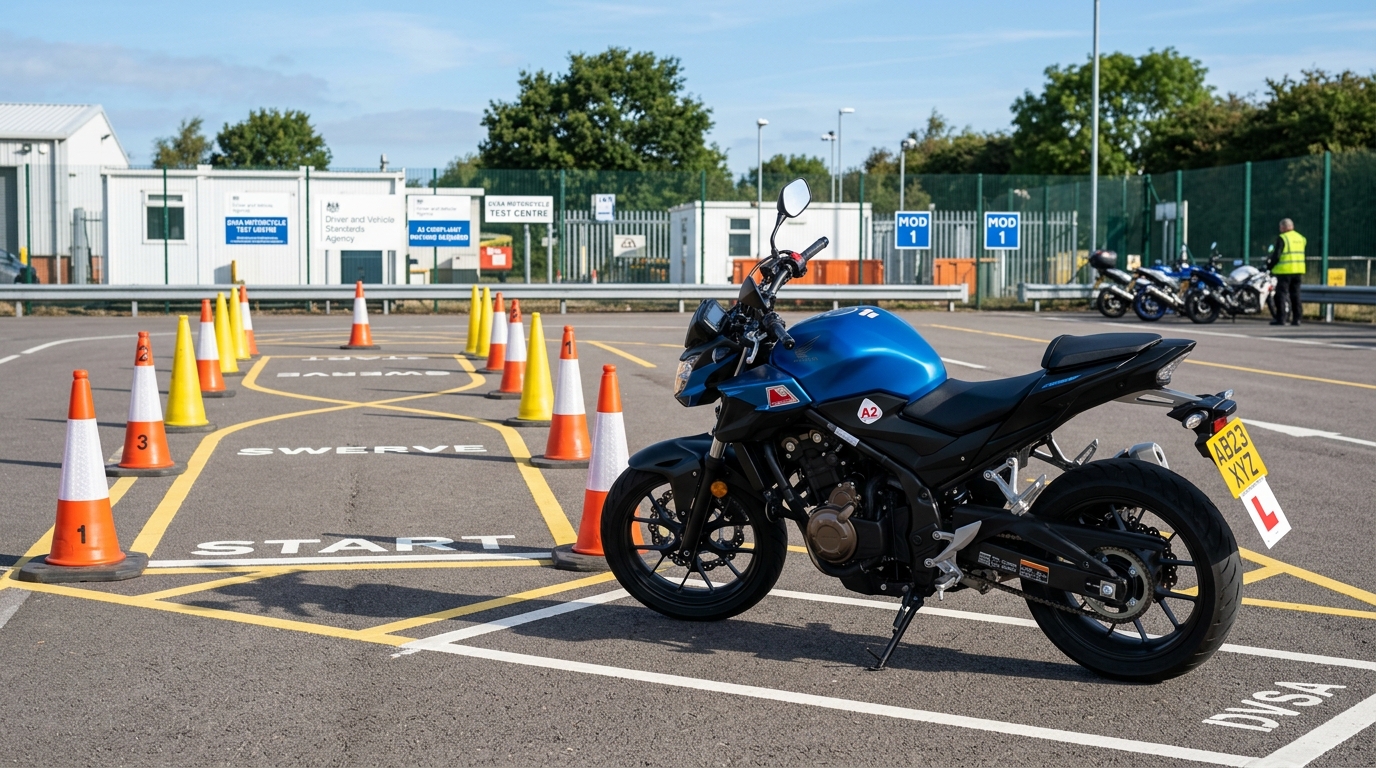
- Module 1 (Off-road): Conducted at a multi-purpose test centre covering emergency braking, hazard avoidance, slow control, and wheeling the bike.
- Module 2 (On-road): 40-minute road ride assessing road positioning, independent navigation, traffic awareness, and safety.
Your qualifying category depends on your age and test machine: A1 (17+ up to 125cc), A2 (19+ up to 35 kW / 47 bhp), or Category A (Direct Access Scheme / DAS) at age 24+ (or age 21+ via progressive access). Check standard GB rules with our UK motorcycle licence calculator. Northern Ireland licensing operates under DVA rules via nidirect.
What age can you ride a motorcycle in the UK?
What age can you ride a motorcycle in the UK?
In the UK, the minimum age depends strictly on the category and power output of the motorcycle:
- Age 16 (Category AM): Mopeds up to 50cc with a maximum design speed of 28 mph (45 km/h), after completing CBT.
- Age 17 (Category A1): Light motorcycles up to 125cc with a power output up to 11 kW (14.8 bhp) and power-to-weight ratio not over 0.1 kW/kg, after CBT or full A1 practical test.
- Age 19 (Category A2): Medium motorcycles producing up to 35 kW (47 bhp) with a power-to-weight ratio not exceeding 0.2 kW/kg (and not derived from a vehicle producing more than double its power, i.e. 70 kW max), after passing Module 1 and 2 tests.
- Age 21 (Category A Progressive Access): Unrestricted motorcycles of any engine size or power, provided you have held a full A2 licence for at least 2 full years and pass the Category A practical test.
- Age 24 (Category A Direct Access Scheme / DAS): Ride any unrestricted motorcycle directly by passing CBT, motorcycle theory, and Module 1 & 2 tests on a Category A machine without prior experience.
Use our licence eligibility checker to confirm which bikes match your age and qualification.
How long does it take to get a motorcycle licence?
How long does it take to get a motorcycle licence?
Most UK riders obtain a full licence within 3 to 8 weeks, though this depends primarily on training format and local DVSA test waiting times:
- CBT (1 day): Usually completed in 6 to 8 hours.
- Motorcycle Theory Test (1–2 weeks): Time needed for revision and securing a test slot at a local theory centre.
- Practical Training & Tests (Module 1 and 2): Training schools offer intensive courses (typically 4 to 6 full days spread over 1 to 2 weeks) or weekend lessons over 4 to 6 weeks.
Module 1 (off-road handling) must be passed before taking Module 2 (road riding). If you fail Module 1, DVSA rules require a 3-working-day waiting period before a re-test; failing Module 2 requires a 10-working-day wait. Booking early in spring or autumn can shorten wait times compared to peak summer.
How do you learn to ride a motorcycle in the UK?
How do you learn to ride a motorcycle in the UK?
To learn to ride safely and legally in the UK, follow this progression:
- Book CBT with a DVSA-approved training body (ATB): You do not need prior experience. Training centres supply protective gear, helmets, and learner motorcycles (automatic scooters or 125cc geared bikes).
- Master the foundational controls: Learn the clutch "friction zone", smooth throttle opening, coordinated front and rear braking, and counter-steering in a closed, off-road compound.
- Complete the road ride element: Spend at least 2 continuous hours riding on public roads under constant radio instruction.
- Gain roadcraft with instructor-led lessons: While CBT allows riding with L-plates, taking structured professional training on school motorcycles is the safest route to develop anticipation, lane positioning, and Module 1/Module 2 test competency.
How much is motorcycle insurance, and how can you get cheaper cover?
How much is motorcycle insurance, and how can you get cheaper cover?
Motorcycle insurance premiums in the UK typically range from £150 to £400 per year for experienced riders in lower-risk areas, but can reach £800 to £2,000+ for new riders, young riders, or those living in urban theft hotspots like central London.
Key factors influencing your premium include your postcode, overnight storage location, age, claims history, and the motorcycle’s insurance group and value.
To reduce your motorcycle insurance costs:
- Use Sold Secure approved physical locks: Use Sold Secure Powered Cycle Gold or Diamond rated ground anchors, heavy chains (16mm+), and disc locks. Review our motorcycle security guide.
- Secure off-street overnight parking: Storing your bike in a locked brick garage or alarmed shed significantly lowers theft premiums compared to on-street parking.
- Fit a Thatcham-approved tracker or alarm: Insurers often offer discounts for Category 1 alarms or Category S5/S7 tracking units.
- Limit declared mileage accurately: Don't overestimate your commuting and leisure miles.
- Increase voluntary excess: Choosing a higher excess lowers your annual premium, provided you can afford the outlay if making a claim.
- Consider advanced rider qualifications: Passing IAM RoadSmart or RoSPA advanced tests can unlock specialist insurance discounts.
Model your annual riding expenses with our motorcycle running-cost calculator.
How much is a motorcycle MOT in the UK?
How much is a motorcycle MOT in the UK?
In Great Britain, the official statutory maximum test fee set by the DVSA is £29.65 for a standard solo motorcycle (Class 1 up to 200cc, Class 2 over 200cc), and £37.80 for a motorcycle with a sidecar.
Motorcycles require an MOT once they reach 3 years from the date of first registration, and annually every 12 months thereafter. Northern Ireland operates under separate DVA testing centres and fee structures. Check official test guidelines on GOV.UK MOT test fees.
Before your test, check easy failure points: tyre tread depth (minimum 1mm across the central three-quarters in the UK), tyre pressures, headlight and indicator function, horn, brake pad thickness, chain tension, and steering head bearings.
How long do motorcycle helmets last?
How long do motorcycle helmets last?
Motorcycle helmet manufacturers (including Arai, Shoei, AGV, and Shark) and safety agencies recommend replacing a motorcycle helmet every 3 to 5 years of regular use, or 7 years from its date of manufacture (found on a label beneath the comfort liner).
Key reasons helmets must be replaced periodically:
- EPS liner deterioration: The internal expanded polystyrene (EPS) liner that absorbs kinetic impact energy degrades over time from hair oils, sweat, ozone, UV rays, and environmental temperature extremes.
- Immediate replacement after any impact: If your helmet is involved in a collision or dropped heavily onto a hard surface (such as concrete), it must be replaced immediately. The EPS liner crushes permanently to absorb energy, and internal damage cannot be determined by inspecting the outer paint shell.
- Regulatory standards: When replacing your helmet, look for the current ECE 22.06 certification standard and cross-reference independent crash results on the UK Government SHARP helmet database. Read our detailed helmet safety and fit guide.
What does "cc" mean on a motorcycle?
What does "cc" mean on a motorcycle?
"CC" stands for cubic centimetres (cm³) and measures the total engine displacement—the physical volume swept by all the engine's pistons moving between bottom dead centre and top dead centre.
While engine capacity gives an indication of engine size, displacement alone does not define power output or legal riding eligibility:
- Capacity vs Power: A relaxed 650cc twin-cylinder cruiser may output 35 kW (47 bhp), making it A2 licence compliant, whereas a 600cc high-revving four-cylinder supersport can generate over 88 kW (118 bhp), requiring an unrestricted Category A licence.
- Licence Limits (kW): UK A1 (max 11 kW) and A2 (max 35 kW / 0.2 kW/kg) licence categories are restricted by kilowatt output and power-to-weight ratio, not cc alone.
- UK Vehicle Tax (VED): UK motorcycle road tax is banded strictly by engine capacity. For 2026/27, the standard annual rates are £27 (up to 150cc), £59 (151–400cc), £90 (401–600cc), and £125 (over 600cc).
How do you change gears on a manual motorcycle?
How do you change gears on a manual motorcycle?
Standard manual motorcycles use a sequential gearbox operated by your left hand (clutch lever) and left foot (gear lever). The standard pattern is 1-N-2-3-4-5-(6) (one down, neutral half-click up, four or five up).
To change up (upshifting):
- Accelerate smoothly to your desired shift point in the current gear.
- Roll off the throttle slightly while pulling the clutch lever in towards the handlebar.
- Slide your left boot toe under the gear lever and lift up firmly until you feel a positive click.
- Smoothly release the clutch lever while simultaneously rolling back on the throttle.
To change down (downshifting):
- Roll off the throttle and apply progressive braking if slowing down.
- Pull the clutch lever in fully.
- Press the gear lever downwards firmly with the ball of your left foot.
- Gently "blip" (briefly flick) the throttle to match engine revs to road speed, then smoothly release the clutch lever.
Finding Neutral (N): Neutral is located midway between 1st and 2nd gear. From 1st gear, apply a gentle half-click upwards until the green "N" dashboard indicator illuminates.
What do you need to ride a motorcycle in France from the UK?
What do you need to ride a motorcycle in France from the UK?
When riding a UK-registered motorcycle in France, you must carry and comply with specific legal requirements:
- Essential documentation: Valid UK photocard driving licence, V5C logbook (or VE103 certificate if the bike is hired, leased, or borrowed), valid UK motorcycle insurance certificate (check with your insurer for European cover limits), and valid MOT certificate.
- UK identification: A visible "UK" sticker on the rear of the motorcycle or a UK national identifier on the number plate (the older "GB" identifier is no longer legally valid).
- Mandatory helmet reflective stickers: Under French traffic law, motorcycle helmets must have four retro-reflective stickers fitted (one front, one rear, one left, one right).
- CE-approved protective gloves: Wearing CE/NF certified motorcycle gloves is mandatory for both rider and pillion passenger in France.
- High-visibility safety vest (gilet): You must carry an EN 471 / ISO 20471 compliant hi-vis vest on the motorcycle (not required to be worn while riding, but must be put on immediately in an emergency or roadside breakdown).
- Crit'Air clean air vignette: If riding through French low-emission zones (ZFE-m) such as Greater Paris, Lyon, Toulouse, or Marseille, you must purchase and display an official French Crit'Air vignette on your fork or fairing before travel.
- Headlights: Ride with dipped headlights on at all times, and ensure beam aim does not dazzle oncoming traffic on the right-hand side of the road.
Where can you recycle a motorcycle battery in the UK?
Where can you recycle a motorcycle battery in the UK?
Motorcycle batteries (lead-acid, AGM, gel, and Lithium-ion) contain corrosive sulphuric acid, lead, and hazardous heavy metals. Under UK environmental law, they must never be put into domestic household wheelie bins.
You can recycle motorcycle batteries for free at the following UK locations:
- Local Authority Recycling Centres (HWRC): Every local council civic amenity site / municipal recycling tip has a designated, bunded container for lead-acid automotive and motorcycle batteries.
- Motorcycle garages and auto parts retailers: Retailers and motor factors (including Halfords and independent motorcycle dealerships) operate free take-back schemes under the UK Waste Batteries and Accumulators Regulations, particularly when you purchase a replacement battery.
- Licensed scrap metal merchants: Registered scrap dealers accept lead-acid batteries and will frequently pay scrap value by weight via bank transfer or cheque (cash payments for scrap metal are illegal under the Scrap Metal Dealers Act 2013).