Start with the ride, not the badge.
A Harley-Davidson can mean a low-slung cruiser, a touring machine with luggage and a fairing, a sport-oriented model, an adventure bike, or a trike. That breadth is part of the appeal. It also makes the question “what is the best Harley-Davidson?” impossible to answer honestly without knowing who is asking.
Picture your ordinary Saturday, not the perfect one. Are you threading through town, taking a passenger across the country, riding to work whatever the weather, or heading out for a long solo loop? Will the bike live in a narrow garage or outside? Do you need to push it backwards up a slope? Those details are not boring admin; they are what make a bike feel right after the first exciting month.
My view: choose a use case before you choose a model. A beautiful motorcycle that is awkward to turn around in your own drive can become a source of stress. A bike that suits your pace, body and parking situation is much more likely to earn its keep.
The UK range changes. Start with the official Harley-Davidson UK motorcycle range, then confirm that the exact model, trim and model year are offered here. A model appearing in a search result—or in another country’s catalogue—does not prove it is a current UK model.
Choose a model family for the roads you ride.
The range spans cruisers, touring bikes, sport models, adventure touring and trikes. Those labels are useful starting points, not a promise that every category or named model is currently on sale in the UK. The right choice comes down to the roads you ride, the distance you cover and how much comfort or practicality you need.
- Cruisers: often the first image people have of the brand. Compare foot-control position and steering reach as carefully as seat height. Fat Boy, Fat Bob, Breakout, Nightster and Sportster S are among the models you may encounter.
- Touring: look at wind protection, luggage, passenger comfort, manoeuvring weight and the kind of roads you will cover. When comparing, for example, a Street Glide with a Street Glide Limited, use the equipment list for the exact UK model year rather than relying on an overseas review or name alone.
- Sport and lighter models: Sportster is a broad name. Sportster S and Sportster 883 refer to different motorcycles and eras; do not assume an older 883 listing describes the current range.
- Adventure touring: models such as the Pan America offer a different riding position and intended use from a traditional cruiser. “Adventure” does not mean every version or rider is ready for every trail; consider weight, tyres, protection and your experience.
- Trikes: three wheels change the licence questions as well as the handling. Confirm the exact vehicle classification and your entitlement before riding; do not assume the rules for a two-wheel motorcycle apply unchanged.
Model names travel across markets and generations. The X440, V-Rod, Road King and Sportster 883 may lead to market-specific information or older used bikes, so check the official UK range before assuming a model is available new here. Treat every used listing as an individual motorcycle with its own history.
Once you have a shortlist, compare each bike’s seat, running weight and posture with our Bike Fit Checker. It is a specification comparison, not a physical fit assessment. Sit on the motorcycle and arrange a proper test ride where available. On touring models, check whether the specific trim includes the screen, luggage and passenger equipment you want; confirm engine names such as Milwaukee-Eight 117 VVT and phone connectivity against that same model-year specification.
That shortlist also needs to make sense for your body and your budget, so take the time to assess what the bike will feel like at walking pace before comparing prices.
Weight, seat height and the moment you stop.
There is no one-number answer to a Harley-Davidson’s weight. It varies by model, equipment, trim and year. Check whether the published figure is running/kerb weight or a dry figure, and compare like with like. A touring model carrying luggage and a smaller cruiser are not interchangeable just because both have the same badge.
Weight is not just a specification to glance at in a showroom. It is the push away from a cambered parking space, the tight turn on a narrow lane, the slow U-turn when you miss a junction, and the awkward moment when the bike starts to lean while stationary. A low centre of gravity may help a motorcycle feel settled, but it does not make a heavy motorcycle weightless when you are moving it by hand.
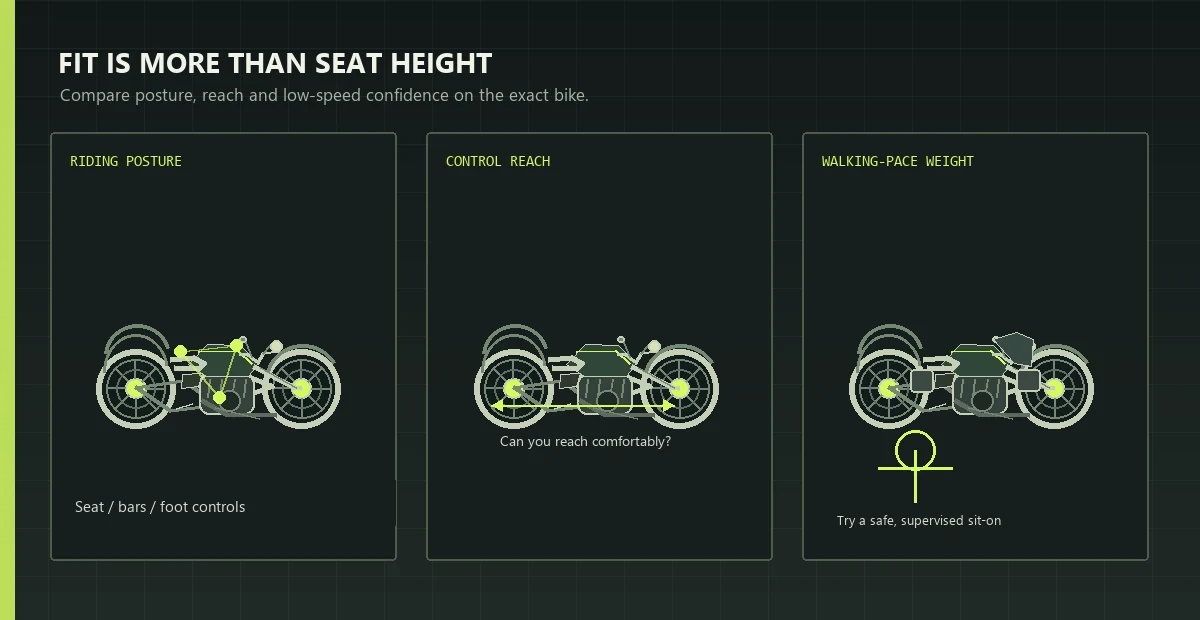
Seat height matters, but it is not the whole fit story. A wide seat can spread your legs and make the reach to the ground feel longer. Bars that are too far away can make full-lock turns uncomfortable; foot controls that do not suit your hips or knees can become tiring. Sit on the bike in your normal riding boots, hold it upright with help, and check the controls at full steering lock. A comparison chart cannot tell you how secure you will feel.
Use our motorcycle fit comparison as a shortlist tool, then verify exact UK specifications with the manufacturer. The Harley-Davidson brand hub currently uses a Nightster specification reference from another market and labels that limitation clearly; do not treat it as a confirmed UK figure.
Build a UK ownership budget beyond the showroom price.
There is no responsible single answer to the price of a Harley-Davidson. The figure depends on model, year, trim, whether it is new or used, condition, mileage, optional equipment and seller. New-bike prices and dealer offers can change, and used asking prices are not completed sale prices. Check a current UK listing for the exact bike you have in mind.
If you are searching “Harley-Davidson for sale” or “Harley-Davidson bikes”, compare more than the headline price. Ask what is included, check the registration and service history, and compare the same model year and condition. Do not assume a finance payment is the total cost or that a dealer’s advertised offer applies to every buyer.
Then budget for ownership: insurance quotes for your own details, fuel, routine service, tyres, consumables, road tax where applicable, secure storage and any accessories you genuinely need. Our UK motorcycle running-cost tool helps organise some of those costs, but it does not produce an insurance quote or a live Harley-Davidson price. Get those figures directly before committing. Warranty is another cost question: ask the seller for current written terms for the exact bike and registration, including exclusions and what maintenance records are required.
My opinion is simple: if the purchase only works when you ignore the next service, a set of tyres or secure parking, it does not yet work. Leave room for the unglamorous costs. They are part of owning the motorcycle, not an optional footnote.
The same discipline applies to resale. Age, model, condition, mileage, originality, service evidence, modifications and local demand all affect what a bike might later sell for. Compare like-for-like asking prices, but do not treat them as a promise of future value.
Once the numbers are plausible, turn to the less glamorous paperwork and condition checks. They can matter more than a small difference in the asking price.
Buy the motorcycle in front of you, not a reputation.
Reliability deserves a careful answer, not a fan’s blanket yes or a critic’s blanket no. It depends on the motorcycle, model year, maintenance, storage, use and modifications. We do not have a representative long-term reliability dataset or independent test results for every model, so we will not invent a brand-wide score or claim that one model year is trouble-free.
Shopping specifically for an 883? Our used Sportster 883 buying guide explains the model-year milestones, inspection questions and ownership budget, with a downloadable viewing checklist.
For a used bike, evidence beats reputation. Before buying, always:
- Review the paperwork: Ask for maintenance invoices and the owner’s manual to ensure the service schedule matches the exact model and year.
- Inspect the condition: Look for unexplained wiring changes, poorly fitted accessories, fluid leaks, corrosion and damage.
- Listen to it run: A cold start can reveal issues a warmed-up engine might hide.
- Get a professional opinion: A careful inspection by a mechanic familiar with the model reveals more than a polished advert. Do not diagnose a fault from a search snippet.
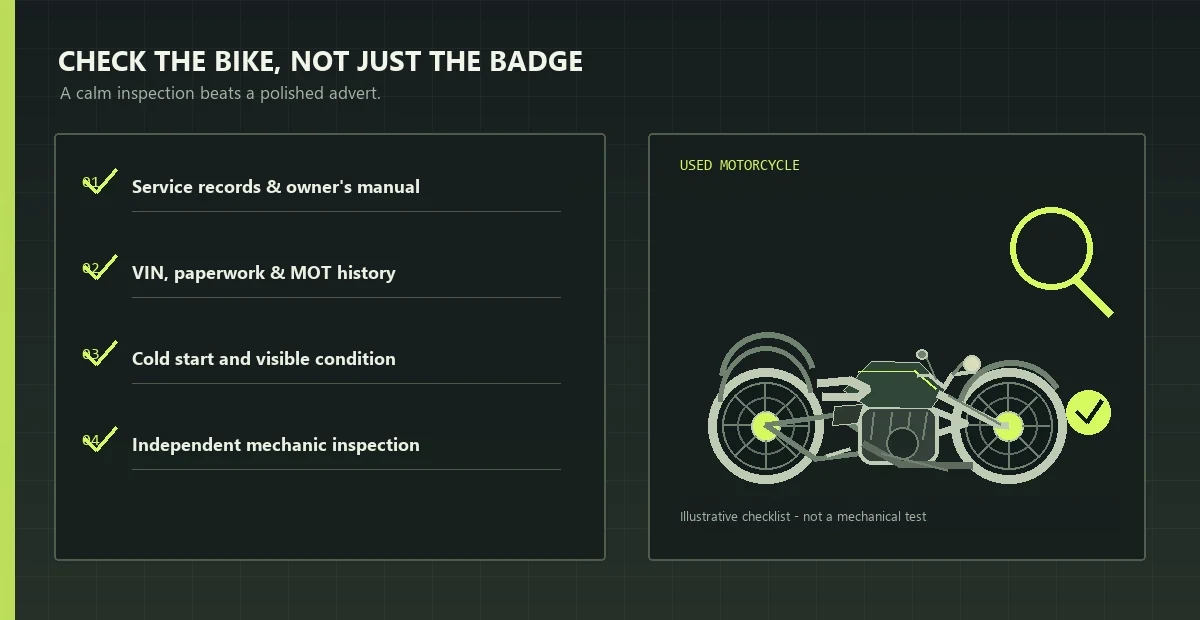
Check the registration, MOT history and tax status using official services, and make sure the VIN and paperwork agree. A fresh MOT is useful information, not a guarantee of mechanical condition. Ask the seller about outstanding finance and whether the motorcycle has been written off or stolen; use a reputable vehicle-history check if needed.
UK rain and winter road salt make storage and cleaning worth discussing. Look closely for corrosion, especially where dirt or salt can sit, and ask how the bike was stored. That is sensible inspection, not proof that every Harley is unusually vulnerable to British weather.
There is no honest universal list of “Harley-Davidson years to avoid” without reliable evidence for the exact model. Online owner forums can help you discover what to ask about, but separate an individual account from a documented recall, service bulletin or recurring verified defect. If the question is “which Harleys to stay away from?”, the most useful response is: avoid any specific motorcycle whose history, condition or paperwork does not stand up to inspection.
Engine size, power and the A2 question.
Engine capacity depends on the model and year. Cubic centimetres tell you the engine’s size, but not its power, weight, licence category or whether it can be restricted legally. The UK A2 category has power and power-to-weight requirements, including a limit on the original unrestricted power of a motorcycle that is restricted. Check the bike’s documented specification and the current rules—not just its badge or engine size.
In Great Britain, an A2 motorcycle must not exceed 35 kW, must stay within the 0.2 kW/kg power-to-weight limit, and cannot be restricted from a motorcycle with more than 70 kW original power. Before buying for an A2 rider, ask an authorised UK dealer for the exact variant and written restriction documentation. Confirm the motorcycle satisfies the current legal criteria and that your licence entitlement covers it. A restriction kit or a “should be fine” answer is not enough. Use the licence eligibility tool as a starting point and verify the result against GOV.UK motorcycle categories.
Those GOV.UK routes describe Great Britain. Northern Ireland has a separate licensing information service; NI riders should check nidirect’s motorcycle and moped rules. Do not use a GB summary as a substitute for NI guidance.
Once the licence and model check out, the service history is the next piece of evidence to inspect.
Service records tell you how the bike was treated.
Service intervals depend on model and year, so do not copy a schedule from a different engine or an online forum. Find the owner’s manual and maintenance schedule for the exact motorcycle through Harley-Davidson’s Service Information Portal, then ask the seller to match invoices to that schedule. Missing paperwork does not automatically prove neglect, but it leaves you with more uncertainty—and uncertainty should affect what you are willing to pay.
For a bike intended for UK use, include corrosion, tyre age and condition, brakes, belt or drive condition where relevant, battery health, keys, security equipment and accessories in your inspection. A good-looking machine can still have expensive work due.
If you are buying from a dealer, get any warranty terms in writing for the exact motorcycle and VIN. Check what is covered, for how long, what exclusions apply and which service records are required. “Approved” is not a substitute for reading the terms.
Read buying guides with a critical eye.
Dealer guides can be useful for understanding a current range and the questions buyers should ask. For example, Blade Motorcycles’ 2026 guide discusses model categories, weight in traffic, servicing, UK weather, A2 compatibility, infotainment, warranty and resale, alongside links to its own bikes and offers. That is useful context, but verify each specification against the official UK listing and read the terms attached to any offer.
MCN’s Harley-Davidson hub brings together listings, video reviews, road tests, model coverage and news. That breadth can help you research a shortlist. Still, no collection of articles can tell you how a particular motorcycle feels beneath you or whether its service history is sound.
That is the practical gap this guide aims to address: connect model choice to your real riding, fit, licence, budget and the condition of the bike you are considering. We have not ridden every model discussed here, and we will not dress up a specification comparison as a road test. Before making a decision, check the manufacturer’s current UK information and inspect the actual motorcycle.
Sources & further reading
- Harley-Davidson UK: motorcycle range
- Harley-Davidson Service Information Portal
- GOV.UK: Motorcycle licence categories and age requirements
- nidirect: Motorcycles and mopeds you can ride
- GOV.UK: Check MOT history
- GOV.UK: Check vehicle tax
- Blade Motorcycles: 2026 UK buyers guide and ownership FAQs
- MCN: Harley-Davidson guide
Specifications, prices and rules can change. Check the linked primary source before making a purchase or riding decision. Our editorial standards.