⚡ 1. DAS vs A2 Core Comparison: Statutory Rules, Age & Minimum Test Machines
Choosing between the Direct Access Scheme (DAS) and an A2 motorcycle licence is the most critical decision a prospective UK motorcyclist will make. While both pathways lead to a full motorcycle licence with the right to carry pillion passengers and ride on motorways without L-plates, they differ substantially in minimum age requirements, the machinery you must ride during the DVSA practical examinations, and what you are legally permitted to ride immediately after tearing up your learner bib.
The UK motorcycle licensing system is governed by the Motor Vehicles (Driving Licences) Regulations 1999 as amended, aligned with European Third Driving Licence Directive standards. Under this statutory framework, motorcycle licences are divided into graduated categories:
- Category A2 (Medium Motorcycles): Designed for riders aged 19 and over. You take your test on a motorcycle displacing at least 245cc producing between 20 kW and 35 kW. Once licensed, you are legally restricted to motorcycles producing a maximum of 35 kW (46.9 bhp) with a maximum power-to-weight ratio of 0.20 kW per kilogram.
- Category A / Direct Access Scheme (Unrestricted Motorcycles): Designed for riders aged 24 and over (or aged 21 and over via the staged progressive access route). You take your test on a large motorcycle displacing at least 595cc producing at least 50 kW (67 bhp). Once licensed, you hold an unrestricted Category A licence permitting you to ride any motorcycle of any engine capacity, horsepower, or weight immediately.
| LICENCE PARAMETER | CATEGORY A2 (MEDIUM BIKE) | DIRECT ACCESS SCHEME (CATEGORY A) | PROGRESSIVE ACCESS (STAGED A2 → A) | CATEGORY VERDICT |
|---|---|---|---|---|
| Minimum Qualifying Age | 19 years old | 24 years old | 21 years old (Held A2 for 2+ years) | 🏆 A2 Starts at 19 |
| Road Riding Power Limit | Max 35.0 kW (46.9 bhp) | No limit (Unlimited bhp) | No limit (Upon passing Category A tests) | 🏆 DAS Full Freedom |
| Power-to-Weight Ratio | Max 0.20 kW / kg | No limit | No limit | 🏆 DAS Unlimited |
| Donor Power Restriction Ceiling | Max 70 kW (93.8 bhp) unrestricted | Not applicable | Not applicable | 🏆 DAS No Ceiling |
| Minimum Test Bike Capacity | At least 245cc | At least 595cc | At least 595cc | 🏆 A2 Easier Machine |
| Minimum Test Bike Power | 20.0 kW to 35.0 kW | At least 50.0 kW (67 bhp) | At least 50.0 kW (67 bhp) | 🏆 A2 Lighter Throttle |
| Minimum Test Bike Kerb Mass | At least 115 kg (unladen) | At least 175 kg (unladen) | At least 175 kg (unladen) | 🏆 A2 Less Weight |
| Theory Test Retake Required? | Yes (Valid for 2 years) | Yes (Valid for 2 years) | No (Theory exempt if A2 held) | 🏆 Progressive Saves Theory |
| Motorway & Pillion Entitlement | Full entitlement granted**Carrying a passenger requires factory dual seat & pillion footpegs | Full entitlement granted | Full entitlement granted | 🏆 All Grant Full Road Rights |
*Pillion passenger note: While Category A2 and DAS both grant legal entitlement to carry pillion passengers on public roads and motorways without L-plates immediately upon qualifying, the motorcycle itself must comply with Regulation 16 of the Road Vehicles (Construction and Use) Regulations. It must be physically equipped with a dual seat, secure passenger handholds or a grab strap, and dedicated pillion footrests. Several track-styled or lightweight A2 machines ship with single-seat cowls or lack passenger footpeg hangers, requiring an official manufacturer pillion kit before passengers can legally be carried.
The motorcycle you ride for your DVSA practical test must meet strict statutory criteria. For Category A (DAS), the test machine must displace at least 595cc, produce at least 50 kW, and weigh at least 175 kg. If you turn up on a motorcycle producing 49 kW or displacing 580cc, the DVSA examiner will cancel your test on the spot, and you will forfeit your test fee. Commercial motorcycle schools provide certified test-compliant fleet bikes (such as the Yamaha MT-07, Kawasaki Z650, or Suzuki SV650) to guarantee compliance.
If you take your DVSA Module 1 and Module 2 tests on an automatic motorcycle or twist-and-go maxi-scooter (such as a Honda NC750D with Dual Clutch Transmission or a Yamaha TMAX), your full driving licence will carry DVLA restriction code 78 (restricted to vehicles with automatic transmission). This legally prohibits you from riding any manual motorcycle with a clutch lever and foot-operated gear shifter. If you later wish to ride a manual motorcycle, you must retake and pass both Module 1 and Module 2 on a manual machine. Conversely, passing your test on a manual geared motorcycle entitles you to ride both manual and automatic motorcycles with zero restrictions.
Verify whether your current or prospective machine meets legal licensing limits using our interactive UK Licence & A2 Eligibility Calculator, and estimate your annual ownership running costs with our UK motorcycle running costs estimator.
📐 2. The 5-Step Practical Roadmap: From CBT to Full Licence
Whether you choose the Direct Access Scheme or the Category A2 route, every UK motorcyclist must navigate the exact same sequential five-step testing framework. The DVSA does not alter the curriculum, the cone layout, or the road marking criteria between licence tiers; only the engine displacement and power output of your training motorcycle change.
Step 1: Provisional Motorcycle Entitlement & Eyesight Verification
Before touching a motorcycle on a public road, you must hold a valid UK driving licence with provisional motorcycle entitlement (Category A). If you hold a full UK car driving licence, this entitlement is usually added automatically. If you hold a provisional driving licence, ensure Category A is listed on the back of your photocard.
You must also satisfy the statutory eyesight standard. In good daylight, you must be able to read a standard vehicle number plate (made after 1 September 2001) from a distance of 20.0 metres (approximately 66 feet), with glasses or corrective contact lenses if worn.
Step 2: Compulsory Basic Training (CBT)
Compulsory Basic Training is a statutory one-day course designed to ensure you can ride safely on your own while learning. Governed by a certified DVSA motorcycle instructor, the CBT course follows five mandatory elements:
- Element A: Introduction: Overview of protective clothing (helmets, CE armour, boots, gloves) and motorcycle ergonomics.
- Element B: Practical Machine Training: Familiarisation with motorcycle controls, routine maintenance checks, and taking the motorcycle on and off its stands.
- Element C: Practical On-Site Riding: Clutch control, biting point mastery, gear selection, slow riding, emergency braking, figure of eight, and left and right turns on an off-road tarmac training area.
- Element D: Practical On-Road Preparation: Pre-ride safety briefing, Highway Code rules, legal requirements, hazard awareness, and defensive road positioning.
- Element E: Practical On-Road Riding: A minimum of two hours of radio-linked road riding on public roads under direct instructor supervision.
Upon successful completion, your instructor issues a DL196 certificate. This certificate is valid for exactly two years. It permits you to ride a learner-legal machine (up to 125cc producing no more than 11 kW) displaying front and rear red L-plates (or D-plates in Wales). You cannot carry pillion passengers or ride on motorways on a CBT certificate alone.
Step 3: DVSA Motorcycle Theory Test & Hazard Perception
Even if you hold a full UK car driving licence, you must pass a dedicated motorcycle theory test before booking your DVSA practical motorcycle tests. The test is administered at an official Pearson VUE test centre on behalf of the DVSA (cost: £23.00) and comprises two sections:
- Multiple Choice Section: 50 questions covering road signs, motorcycle dynamics, loading, environmental rules, and safety margins. The pass mark is 43 out of 50 (86%).
- Hazard Perception Section: 14 computer-generated video clips presenting everyday road scenes. Thirteen clips feature one developing hazard, while one clip features two developing hazards. You must score at least 44 out of 75 points (58.6%).
Your motorcycle theory test pass certificate is valid for two years. If your certificate expires before you pass both practical modules, you must retake and pass the theory test again.
Step 4: DVSA Module 1 Off-Road Maneuvers Test
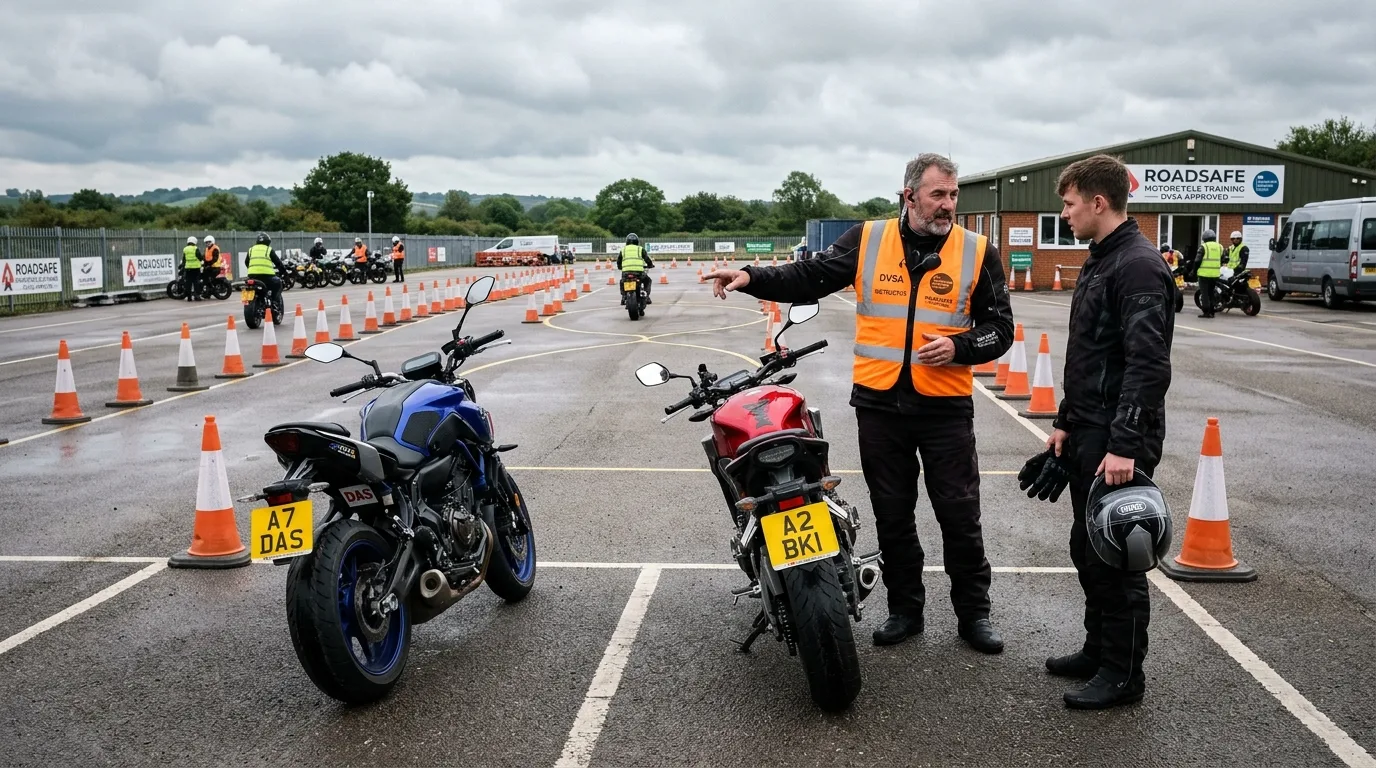
The Module 1 practical test takes place on an enclosed, high-grip multi-purpose test area (MPTA) at an official DVSA test centre. The examiner assesses your low-speed balance, control modulation, and high-speed avoidance without the distraction of public road traffic (statutory test fee: £15.50). The test lasts approximately 10 to 12 minutes and includes eight mandatory exercises:
- Manual Handling & Stand Use: Wheeling the motorcycle backwards into a parking bay dismounted and placing it on its stand.
- Slalom: Weaving in first gear between a line of cones using clutch slip and rear brake.
- Figure of Eight: Executing two consecutive, smooth figure-of-eight turns between two cones.
- Slow Ride: Riding straight at walking pace (3 to 4 mph) without putting a foot down.
- U-Turn: A 180-degree turn between two boundary lines with shoulder lifesaver checks.
- Controlled Stop: Stopping smoothly from ~20 mph inside a four-cone box.
- Emergency Stop: Triggering the speed trap at a minimum of 50 km/h (31.1 mph) and stopping without skidding.
- Hazard Avoidance (Swerve): Passing the 50 km/h trap, swerving cleanly through the cone gate, and stopping in the box.
For both the emergency stop and the hazard avoidance exercise, the statutory target speed is 50 km/h (31.1 mph). If you register between 48 km/h and 49 km/h, the examiner will record a single rider fault (minor) and allow you to proceed, provided the stop or swerve was controlled. However, if your speed drops below 48 km/h, the examiner will require you to repeat the exercise once. If you fail to reach 48 km/h on the second attempt, or if you register below 48 km/h on both separate exercises, the test is marked as an automatic serious fault (fail).
Step 5: DVSA Module 2 On-Road Riding Test
Module 2 is the final hurdle: a 35 to 40 minute comprehensive road ride on public streets with a DVSA examiner following behind on a motorcycle or in a radio-linked car (statutory test fee: £75.00 weekday / £88.50 weekend). The test evaluates your ability to ride safely, assertively, and independently across diverse road conditions, including residential streets, dual carriageways, rural country lanes, and complex multi-lane roundabouts.
The structure of the Module 2 test includes:
- Eyesight Check & Safety Questions: The examiner conducts the 20-metre plate check, followed by one "Tell Me" vehicle maintenance question before setting off, and one "Show Me" dynamic operational question while stationary or on the road.
- Road Ride & Radio Direction: The examiner delivers navigational instructions via a one-way radio headset. You are expected to demonstrate textbook road positioning (dominant positioning without hugging kerbs), appropriate speed matching the limit, proactive hazard observation, and frequent mirror and lifesaver blind-spot checks before changing lanes, turning, or passing junctions.
- Independent Riding Section: For approximately 10 minutes, the examiner asks you to follow road signs to a specific destination (e.g. "Follow the signs toward the A38") or follow a diagrammatic route prompt without step-by-step radio cues. If you take a wrong turn safely, you are not penalised; the examiner will guide you back onto the route.
- Special Maneuvers: Normal stops by the kerb, an angled start pulling out from behind a parked vehicle, and a hill start demonstrating confident clutch control without rolling backwards.
To pass Module 2, you must commit no serious or dangerous faults, and accumulate no more than 10 rider faults (minors). Upon passing, the examiner awards you your practical test pass certificate, retains your provisional photocard, and submits your application to the DVLA for your full pink motorcycle licence.
⚖️ 3. Dedicated Pros & Cons Matrix: DAS Direct vs A2 Stepping Stone
Deciding between Direct Access and Category A2 involves weighing immediate machine choice against physical rider confidence, insurance economics, and examination stress. The optimal route depends on your physiological comfort with heavyweight machinery and your realistic long-term riding objectives.
| EVALUATION PILLAR | DIRECT ACCESS SCHEME (CATEGORY A) | CATEGORY A2 (MEDIUM BIKE) | STRATEGIC VERDICT |
|---|---|---|---|
| Machine Fleet Access | Pro: Zero restrictions. You can buy and ride any motorcycle on earth, from a 125cc commuter to a 200 bhp superbike or a 1800cc cruiser. | Con: Capped at 35 kW (46.9 bhp) and 0.20 kW/kg. Heavyweight machines producing over 70 kW in donor trim cannot be restricted. | 🏆 DAS Wins for Freedom |
| Mod 1 Low-Speed Handling | Con: 650cc test machines weigh 185 kg to 215 kg with heavier clutch pulls and snappier low-rpm throttle responses, making slow slalom and U-turns more intimidating. | Pro: 300cc to 500cc test machines weigh 140 kg to 175 kg with featherlight slipper clutches, offering far greater margin for error during tight cone maneuvers. | 🏆 A2 Wins for Ease |
| First-Year Insurance Outlay | Con: Insuring a newly passed rider on a 650cc or 900cc machine in urban UK postcodes frequently costs £1,200 to £2,500 per year. | Pro: Insuring a 35 kW 400cc or 500cc roadster (e.g. Triumph Speed 400 or Honda CB500F) typically costs £450 to £850 per year for new licence holders. | 🏆 A2 Wins for Running Costs |
| Licence Upgrade Friction | Pro: One-and-done test journey. You never need to sit another motorcycle test, pay another test fee, or visit another DVSA centre again. | Con: Upgrading to Category A requires repeating Module 1 and Module 2 on a 650cc machine, incurring secondary test and school hire fees. | 🏆 DAS Wins for Finality |
| Rider Skill Development | Con: New riders on high-torque 700cc+ twins can develop survival habits (throttle hesitation, cornering anxiety) due to excessive machine power. | Pro: Riding a 40 to 47 bhp motorcycle teaches smooth momentum maintenance, active gear shifting, and full-throttle chassis mastery. | 🏆 A2 Wins for Craft |
Many novice riders aged 24 and over automatically assume they must take DAS because of their age. However, if you have shorter legs (inseam under 30 inches) or weigh under 60 kg, wrestling a 205 kg 650cc training bike during the Module 1 manual handling and slow ride exercises can lead to dropped bikes and test failure. Passing on an agile A2 machine (e.g. Honda CB500F or Kawasaki Z400) provides an easier route to full road rights, builds road craft for two seasons, and makes the subsequent Category A upgrade test straightforward.
Examine motorcycle saddle heights, standover reach, and kerb weights across current models with our dedicated Motorcycle Seat Height & Ergonomics Comparator.
💷 4. Real-World UK Licence Budgets: Statutory Fees vs Commercial School Packages
Budgeting for a UK motorcycle licence requires distinguishing between statutory DVSA test fees (the government charge for the test slot) and commercial motorcycle training school packages (which cover professional tuition, school motorcycle hire, commercial fleet insurance, fuel, and accompaniment to the test centre).
Statutory DVSA Government Test Fees
Official DVSA test fees are fixed nationally across England, Scotland, and Wales:
- Motorcycle Theory Test: £23.00
- Module 1 Practical Test (Off-Road): £15.50
- Module 2 Practical Test (On-Road, Weekday): £75.00
- Module 2 Practical Test (On-Road, Weekend / Bank Holiday): £88.50
- Total Statutory DVSA Fee (Weekday): £113.50
Commercial School Training Package Pricing
You cannot legally ride a Category A or Category A2 training motorcycle to a DVSA test centre unaccompanied; you must be accompanied by a DVSA-certified instructor using radio contact. Consequently, almost all candidates book training through an established motorcycle school. Realistic pricing across the UK falls into three standard tiers:
| TRAINING PACKAGE TYPE | TARGET CANDIDATE EXPERIENCE | DURATION | AVERAGE UK COST | WHAT IS INCLUDED |
|---|---|---|---|---|
| Full Novice Package (Zero to Hero) | Complete beginners with no prior two-wheel clutch experience | 5 to 6 Days | £1,150 to £1,450 | CBT course + 125cc gear training + DAS/A2 road training + Mod 1 hire & test + Mod 2 hire & test + all fuel and insurance. |
| Standard Intensive Course | Riders holding a valid CBT with several months of 125cc road experience | 4 Days | £850 to £1,100 | Big bike familiarisation + dedicated Mod 1 pad coaching + Mod 2 mock tests + test fees and bike hire. |
| Fast-Track Refresher / Retake | Experienced road riders, returning motorcyclists, or A2 staged upgrades | 2 to 3 Days | £550 to £750 | Focused Mod 1 drills + road test briefing + practical test bookings and school bike provision. |
| Single Module Retake Day | Candidates repeating Mod 1 or Mod 2 after a test failure | Half Day | £180 to £260 | One-hour warmup lesson + school bike hire + instructor escort + DVSA rebooking fee. |
Regional Training Costs & DVSA Test Lead Times
Commercial motorcycle training package fees vary significantly across the UK. Commercial pad rental, instructor employment costs, and urban fleet insurance create a 25% to 35% pricing divergence between central London and regional training centres:
| UK REGION | TYPICAL 4-DAY DAS COURSE | STANDALONE CBT | PEAK TEST LEAD TIME | PRIMARY COST & BOOKING DRIVERS |
|---|---|---|---|---|
| Greater London & South EastMitcham, Uxbridge, Enfield, Sidcup | £1,100 to £1,450 | £175 to £220 | 10 to 16 weeks | High off-road tarmac pad ground rent, premium instructor salaries, high fleet risk premiums. |
| Midlands & North of EnglandBirmingham, Manchester, Leeds, Sheffield | £850 to £1,050 | £140 to £175 | 4 to 8 weeks | Balanced operating overheads, high training school density, competitive regional pricing. |
| Wales & South WestCardiff, Swansea, Newport, Exeter | £820 to £1,000 | £135 to £165 | 4 to 7 weeks | Accessible training pads, lower commercial rates, moderate winter test slot availability. |
| ScotlandGlasgow, Edinburgh, Aberdeen, Inverness | £800 to £980 | £130 to £160 | 3 to 6 weeks | Shorter seasonal booking queues, highly accessible rural Module 2 test routes. |
| Northern Ireland (DVA)Belfast (Boucher Rd), Craigavon, Coleraine | £750 to £950 | £130 to £160 | 5 to 9 weeks | Independent DVA booking structure, lower commercial fleet running costs. |
Test booking slots at urban DVSA centres fill up rapidly between April and September. If your local centre shows a 12-week wait, look at satellite test centres located 20 to 30 miles outside metropolitan areas. Many candidates also use automated cancellation notification services to pick up short-notice test slots when other riders reschedule.
Personal Protective Equipment (PPE) Outlay
You must bring your own protective gear to your DVSA tests. The examiner will inspect your clothing before allowing you to mount the motorcycle. Turning up in trainers or casual jeans will result in immediate test cancellation with no refund. Budget for the following minimum compliant gear:
- Helmet (ECE 22.06 Approved): £120 to £350. Must fit securely without pressure points. Read our ECE 22.06 and SHARP safety ratings guide.
- Motorcycle Jacket (CE Class AA or AAA): £140 to £320. Must feature certified CE Level 1 or Level 2 shoulder and elbow armour. See our CE motorcycle garment standards guide.
- Riding Trousers / Armoured Jeans (CE Class AA): £90 to £200. Must include fitted knee and hip impact protectors.
- Motorcycle Gloves: £45 to £110. Must be certified to EN 13594 with reinforced palms and knuckle protectors.
- Sturdy Protective Boots: £90 to £220. Must offer rigid ankle bone protection and non-slip soles. Work boots with protruding lace hooks are discouraged by examiners.
- Total Safety Gear Outlay: £485 to £1,200.
🏍️ 5. Motorcycle Eligibility & Restriction Realities: Best Bikes for Each Tier
Understanding the mechanical differences between purpose-built A2 motorcycles and restricted middleweights ensures you choose the right machine for both your test and your first seasons of ownership.
The "Twice Original Output" Restriction Formula
Under UK law, an A2 motorcycle must not produce more than 35 kW (46.9 bhp) and must not exceed 0.20 kW/kg. However, Regulation 4 adds a critical caveat: the restricted machine must not be derived from an engine producing more than double its current restricted power.
This means:
- If you restrict a motorcycle to the statutory maximum of 35.0 kW, the original factory model cannot produce more than 70.0 kW (93.8 bhp).
- If you restrict an older motorcycle to 25.0 kW (33 bhp), the original donor model cannot have produced more than 50.0 kW (67 bhp).
- Ineligible Superbikes: Machines like the Yamaha MT-09 (87.5 kW), Triumph Street Triple 765 (88 kW), Honda CBR600RR (88 kW), or Suzuki GSX-R600 (92 kW) cannot legally be restricted for an A2 licence under any circumstances, because their original factory output far exceeds the 70 kW ceiling.
| MOTORCYCLE MODEL | ENGINE ARCHITECTURE | FACTORY POWER | A2 RESTRICTION METHOD | KERB MASS | TIER VERDICT |
|---|---|---|---|---|---|
| Honda Hornet 500 / CB500F | 471cc Parallel Twin | 35.0 kW (46.9 bhp) | Native Factory Compliant (No kit needed) | 188 kg | 🏆 Best Pure A2 Daily |
| Triumph Speed 400 | 398cc Liquid Single | 29.4 kW (39.5 bhp) | Native Factory Compliant (No kit needed) | 170 kg | 🏆 Best Lightweight Neo-Retro |
| Yamaha MT-07 (A2 Variant) | 689cc CP2 Parallel Twin | 54.0 kW (72.4 bhp) | Electronic ECU Map or Throttle Stop (35 kW) | 184 kg | 🏆 Best Restrictable Middleweight |
| Kawasaki Z650 / Ninja 650 | 649cc Parallel Twin | 50.2 kW (67.3 bhp) | ECU & Throttle Body Restrictor (35 kW) | 188 kg | 🏆 Best Accessible Middleweight |
| Royal Enfield Interceptor 650 | 648cc Air-Oil Twin | 34.9 kW (46.8 bhp) | Native Factory Compliant (No kit needed) | 218 kg | 🏆 Best Classic Cruiser Twin |
| Yamaha MT-09 / Tracer 9 | 890cc CP3 Triple | 87.5 kW (117.3 bhp) | ILLEGAL FOR A2 (Exceeds 70 kW donor ceiling) | 189 kg | 🏆 Full DAS Only |
If you purchase a restricted middleweight motorcycle, you must carry an official Certificate of Restriction issued by a certified dyno facility or franchised dealer. Furthermore, you must explicitly declare the restrictor kit to your motorcycle insurance company. Failing to declare the modification can void your insurance policy, resulting in six penalty points and machine seizure for driving without third-party cover under Section 143 of the Road Traffic Act.
💡 6. Actionable Diagnostic Route Protocol: Which Path Should You Choose?
Follow this sequential diagnostic protocol to choose the safest, most cost-effective path to your UK motorcycle licence based on your age, physical stature, and riding ambitions.
If you are aged 19 to 23, the law leaves no ambiguity: Category A2 is your only legal gateway to big bikes. If you are 24 or older, both Category A2 and Direct Access are legally open to you. If you turn 24 within the next 8 to 12 weeks, consider waiting to avoid taking practical tests twice.
Do you feel confident wheeling and balancing a 200 kg+ middleweight motorcycle? Test your barefoot inseam and arm reach on our Bike Fit Checker. If your inseam is under 30 inches or you have zero prior clutch experience, taking Category A2 on a lightweight 400cc machine drastically reduces the risk of dropping the bike during Module 1 slow-speed cone drills.
Calculate your combined training, test, and first-year insurance outlays using our Running Costs & VED Calculator. A newly qualified 24-year-old on a 700cc DAS bike often pays double the annual insurance premium of an A2 rider on a 400cc twin. If money is tight, the A2 route saves substantial cash during your first two riding seasons.
If you pass A2 at age 19, mark your calendar for your 21st birthday. On that day, after holding your A2 entitlement for exactly two years, you qualify for full Category A via progressive staged access, unlocking unrestricted superbikes three years before direct DAS candidates.
Northern Ireland: DVA Booking, Test Centres & The 45 mph R-Plate Law
If you live or plan to take your motorcycle test in Northern Ireland, several critical statutory differences apply compared to England, Scotland, and Wales:
- DVA Administration (Not DVSA): Motorcycle testing in Northern Ireland is administered by the Driver & Vehicle Agency (DVA) under the Department for Infrastructure (DfI). You cannot book tests through the GOV.UK portal; all test bookings must be processed via the nidirect practical test booking service.
- Minimum A2 Engine Displacement (395cc vs 245cc): While the DVSA in Great Britain accepts test machines from 245cc upwards, the DVA in Northern Ireland strictly requires an internal combustion machine of at least 395cc for Category A2 testing (producing between 20 kW and 35 kW).
- Dedicated DVA Motorcycle Test Centres: Off-road maneuvers and on-road tests take place at six primary DVA test facilities: Boucher Road (Belfast), Craigavon, Coleraine, New Road (Londonderry), Omagh, and Downpatrick.
- The Mandatory 12-Month "R-Plate" Speed Limit (Article 19): Under Article 19 of the Road Traffic (Northern Ireland) Order 1981, any rider who passes a test for Category A1, A2, or Category A is legally classified as a Restricted Driver ("R" rider) for 12 months from the date of passing.
- The 45 mph Statutory Cap: While on "R" status, you must display amber R-plates on a white background at both the front and rear of your machine, and you are strictly capped at a maximum speed of 45 mph (72 km/h) on all public roads, including dual carriageways and motorways. Exceeding 45 mph carries an automatic fixed penalty and three penalty points. Accumulating six penalty points within your first two years revokes your licence under the Road Traffic (New Drivers) Act.
- Contrast with Great Britain: In England, Scotland, and Wales, newly qualified riders face no mandatory speed restrictions; green "P" plates are voluntary, and riders can immediately travel at standard national speed limits.
If you hold a full Northern Ireland driving licence with R-plate status and ride your motorcycle in England, Scotland, or Wales, the 45 mph speed restriction does not apply outside Northern Ireland. However, the moment your wheels return to Northern Irish soil via Cairnryan or Liverpool ferries, the 45 mph statutory limit and R-plate requirement resume until your 12-month anniversary passes.
Direct Interactive Rider Tools: Test Your Real Numbers
Do not guess your licensing eligibility or rely on showroom sales pitches. Put official DVSA and DVLA mathematics to work on your specific profile:
| INTERACTIVE TOOL | PRIMARY CALCULATION ENGINE | DIRECT ACCESS LINK |
|---|---|---|
| UK Licence & A2 Eligibility Calculator | Checks exact age thresholds, 0.20 kW/kg power-to-weight ratio, 35 kW restriction eligibility, and the 70 kW twice-original power ceiling against DVSA rules. | Check Licence Route → |
| UK Motorcycle Running Costs & VED Estimator | Calculates 2026/27 official DVLA road tax bands (£27 to £125), imperial fuel economy, and realistic first-year insurance projections for A2 vs DAS bikes. | Estimate Running Costs → |
| Motorcycle Seat Height & Ergonomics Comparator | Evaluates your barefoot inseam against published saddle heights (690 mm to 830 mm) and kerb weights across dozens of A2 and Category A motorcycles. | Compare Bike Fit → |
Put the regulations into practice: use our verified UK Licence & A2 Eligibility Tool to verify power-to-weight ratios, donor outputs, and licensing milestones before booking your training course.
❓ 7. Frequently Asked Questions: Direct Access (DAS) vs A2 Licences
What is the main difference between Direct Access (DAS) and an A2 motorcycle licence?
The main difference between Direct Access (DAS) and an A2 motorcycle licence is ==the age requirement and the machinery you are permitted to ride==. Direct Access is open only to riders aged 24 and over (or aged 21 with two years on A2) and grants an immediate, unrestricted Category A licence permitting any engine size or power. Category A2 is open to riders aged 19 and over, requires testing on a medium-sized bike (245cc to 35 kW), and restricts road riding to motorcycles producing ==a maximum of 35 kW (46.9 bhp) with a power-to-weight ratio no greater than 0.20 kW/kg==.
Can I do Direct Access if I am under 24 years old?
You can only do Direct Access under age 24 ==if you are at least 21 years old and have held a full Category A2 motorcycle licence for at least two full years== under the progressive staged access route. If you have no prior A2 licence, you cannot take tests on an unrestricted Category A machine until your 24th birthday under UK road traffic law.
Do I need to retake my motorcycle theory test to upgrade from A2 to Category A?
==No, you do not need to retake the motorcycle theory test== when upgrading from an A2 licence to a full Category A licence via progressive access, provided you have held your A2 licence for at least two years. However, you must retake and pass both the DVSA Module 1 off-road and Module 2 on-road practical riding tests on a full Category A machine (at least 595cc and at least 50 kW).
Can I ride a 650cc motorcycle on an A2 licence?
==Yes, you can legally ride a 650cc motorcycle on an A2 licence== provided the machine is restricted to 35 kW (46.9 bhp), satisfies the 0.20 kW/kg power-to-weight limit, and was not derived from a motorcycle producing more than 70 kW (93.8 bhp) in factory trim. Popular 650cc roadsters like the Yamaha MT-07, Kawasaki Z650, and Suzuki SV650 can all be legally restricted for A2 licence holders.
How much does the Direct Access Scheme cost in the UK?
The Direct Access Scheme typically costs ==between £850 and £1,450 in total== when booking through a commercial UK motorcycle training school. This includes statutory DVSA test fees (£23 theory, £15.50 Module 1, £75 Module 2), three to five days of professional road tuition, school training motorcycle hire, commercial insurance, and fuel. Candidates requiring test retakes will pay approximately £180 to £260 per retake day.
What happens if I fail DVSA Module 1 or Module 2?
If you fail Module 1, you must wait ==at least three clear working days== before you can retake the test, and you must pay the £15.50 DVSA test fee again plus school bike hire. If you fail Module 2, you must wait ==at least ten clear working days== before retaking, paying the £75.00 test fee again. If you have Module 1 and Module 2 booked on the same day or within three days of each other and fail Module 1, you will automatically forfeit your Module 2 booking fee.
Sources & further reading
DVSA Test Standards & Booking Portals
- Driver and Vehicle Standards Agency: Motorcycle licence categories and minimum test vehicle requirements
- Driver and Vehicle Standards Agency: Book your practical motorcycle riding test
- Driver and Vehicle Standards Agency: Book your official motorcycle theory test
- Driver and Vehicle Standards Agency: Compulsory basic training (CBT) syllabus and DL196 rules
- DVSA: Full motorcycle test vehicle list of compliant machines
- DVSA: What happens during Module 1 off-road motorcycle test
- DVSA: What happens during Module 2 on-road motorcycle test
Statutory Legislation, DVLA & The Highway Code
- GOV.UK: Riding a motorcycle, moped or motor tricycle in the UK
- Legislation.gov.uk: The Motor Vehicles (Driving Licences) Regulations 1999 (SI 1999/2864)
- Driver and Vehicle Licensing Agency: Driving licence fees and entitlement codes
- The Highway Code: Statutory rules for motorcyclists (Rules 83 to 88)
- Driver & Vehicle Licensing Agency: V5C registration and engine modification notifications
Northern Ireland DVA & Industry Standards
- Driver & Vehicle Agency Northern Ireland: Practical motorcycle riding test rules (nidirect)
- Legislation.gov.uk: Road Traffic (Northern Ireland) Order 1981 (Article 19: Provisions as to newly qualified drivers)
- nidirect: Driver & Vehicle Agency (DVA) practical driving & riding test booking portal
- Motorcycle Industry Association (MCIA): A2 motorcycle classification register
Specifications, prices and rules can change. Check the linked primary source before making a purchase or riding decision. Our editorial standards.