⚡ 1. Start with the Approval Label: ECE 22.06 vs Legacy ECE 22.05
A helmet’s legal road approval and its comparative crash performance answer two fundamentally different questions. In Great Britain, under the Motor Vehicles (Wearing of Protective Headgear) Regulations and Section 16 of the Road Traffic Act 1988, every motorcycle rider and pillion passenger on public roads must wear protective headgear carrying an official certification mark.
The only three standards legally recognized on UK public roads are:
- UNECE Regulation 22.05 or 22.06: Indicated by an encircled capital 'E' followed by the homologating nation's code (e.g. E11 for the UK, E1 for Germany, E3 for Italy) and the regulation number sewn onto the chin-strap webbing. Non-European standards, such as US DOT or Snell M2020, are not legal for UK road use unless they also carry UNECE approval.
- British Standard BS 6658:1985 Type A: Marked with the official BSI Kitemark.
- European Economic Area Standards: Offering equivalent protection to BS 6658:1985 Type A.
Why ECE 22.06 Is Dramatically Superior to ECE 22.05
For over two decades, ECE 22.05 served as the global baseline. However, in January 2024, ECE 22.06 became the mandatory manufacturing standard across the UK and Europe. The new testing regime represents the biggest leap in motorcycle head protection in a generation:
| TESTING CRITERIA | LEGACY ECE 22.05 PROTOCOL | MODERN ECE 22.06 PROTOCOL | SAFETY BENEFIT FOR RIDERS |
|---|---|---|---|
| Impact Drop Velocities | Single fixed speed: 7.5 m/s (~16.8 mph) | Multi-speed spectrum: 6.0 m/s, 7.5 m/s, and 8.2 m/s (~18.3 mph) | Prevents excessively rigid shells that fail to absorb softer, low-speed urban concussions. |
| Rotational Acceleration | Not tested (Linear impact drops only) | Mandatory 45° angled oblique anvil drop at 8.0 m/s | Measures rotational brain shearing, the primary cause of subdural haematoma and diffuse axonal injury. |
| Shell Impact Points | 6 predetermined, fixed strike points | 18 total impact points (including random impact targets) | Eliminates manufacturer "point reinforcement" where shells are reinforced only at known test spots. |
| Visor Penetration Test | Basic optical clarity and shatter resistance | High-speed ballistic test: 6mm steel pellet fired at 60 m/s (134 mph) | Guarantees visors withstand high-speed airborne stone chips and gravel spray without shattering. |
| Accessories & Sun Visors | Tested as bare shell only | Tested with sun visors lowered, intercom housings and camera mounts | Ensures internal drop-down sun visors do not crack into facial bones during frontal impacts. |
Yes. UK law prohibits retailers from importing or distributing newly manufactured 22.05 helmets, but riders who already own a road-legal 22.05 helmet may continue to ride in it until it reaches the end of its physical lifespan (typically 3 to 5 years from first use). However, when purchasing a replacement, insist on an ECE 22.06 label to secure modern rotational impact protection.
📐 3. Try It On Before You Commit: Cranial Head Shapes & Showroom Fit Check
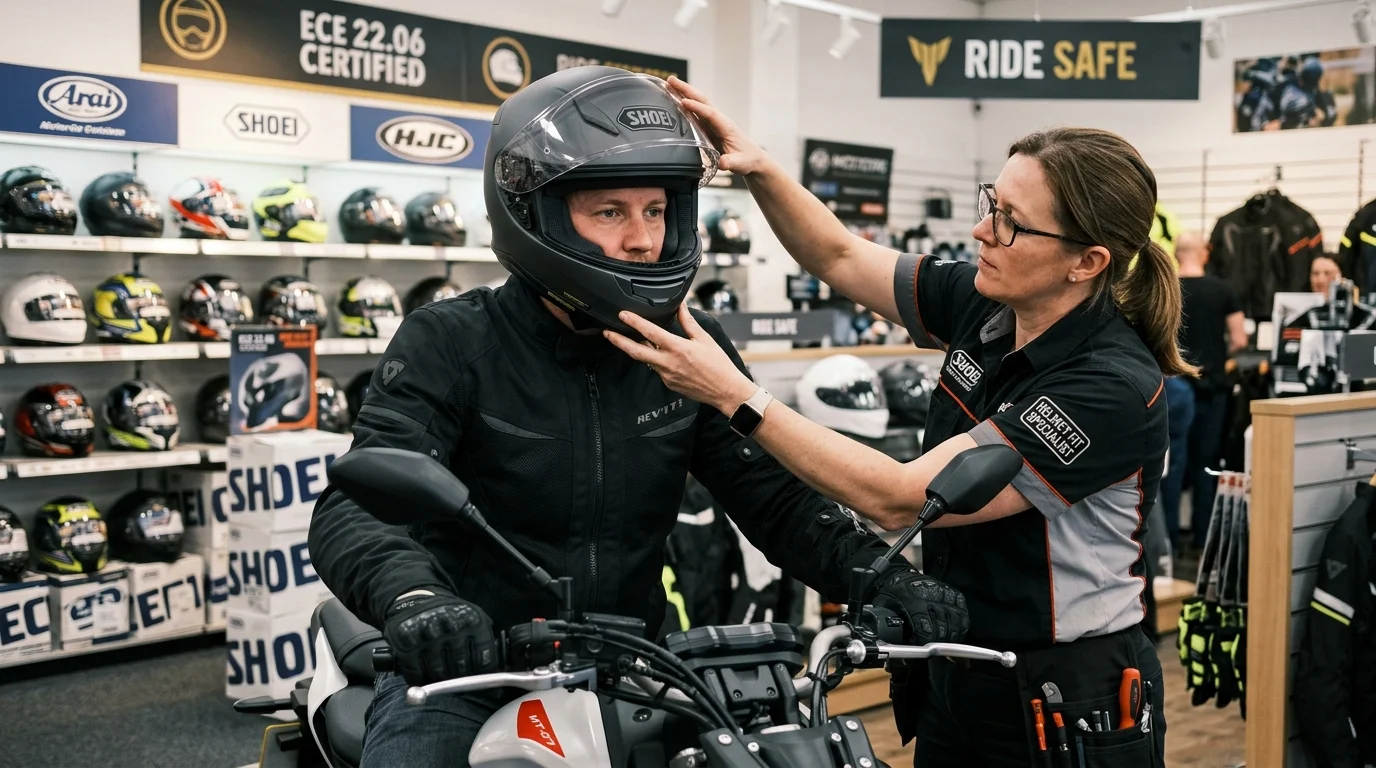
A 5-star SHARP rating and an ECE 22.06 label cannot protect you if the helmet does not fit your skull. If a helmet is too loose, it can rotate or pull off your head during an initial tumble; if it is the wrong cranial shape, localized pressure points will cause crippling headaches, fatigue, and loss of concentration after 45 minutes in the saddle.
The Three Standard Cranial Head Shapes
Human heads are not spherical. Motorcycle helmet shells are sculpted around three distinct anatomical cranial profiles:
Long Oval
The skull is elongated from forehead to occiput. When long-oval riders wear intermediate or round helmets, they suffer intense, burning red forehead pressure spots within 30 to 45 minutes, even though the sides feel loose.
Intermediate Oval
The dominant cranial shape across the UK and European rider population. Pressure is distributed naturally around the crown and temples, offering the widest range of market choices.
Round Oval
The skull is wider at the temples and rounder at the parietal bones. If a round-oval rider wears a narrow helmet, the sides painfully pinch the temples and ears while leaving open space at the brow.
The 5-Step Showroom Fitment Protocol
Never buy a motorcycle helmet purely online based on hat size. Follow this repeatable in-person inspection checklist at an authorised retailer:
- Measure Head Circumference: Place a flexible tailor’s tape around the widest part of your head, roughly 2.5 cm (1 inch) above your eyebrows and passing over the bump at the rear of your skull (the occiput). Compare this exact centimetre measurement against the brand's sizing chart.
- Crown Contact Check: Slide the helmet on. The internal comfort liner should contact the entire perimeter of your scalp with even, firm pressure. You should feel zero hard pressure points pressing directly against your forehead bone or temple ridges.
- Cheek Pad Compression ("Chipmunk Cheeks"): A brand new helmet should push your cheek pads firmly against your cheekbones. If you try to chew gum, you should gently bite your inner cheeks. Helmet liners compress by 10% to 15% after 15 to 20 hours of riding break-in; buying a loose helmet in the showroom guarantees a dangerously sloppy fit later.
- The Roll-Off / Roll-Forward Test: Fasten the chin strap securely (allowing no more than two flat fingers between the strap and your throat). Grasp the bottom rear rim of the helmet with both hands and attempt to pull it upwards and forward off your head. Then push up on the chin bar. If the helmet rolls forward over your eyes or slides back off your forehead, the retention geometry does not fit your skull.
- The 15-Minute Showroom Dwell Test: Wear the helmet in the shop for at least 15 to 20 minutes while browsing. Many pressure hot-spots take 10 minutes to manifest. If your forehead begins to throb or you feel a band of tension, remove the helmet: if you have distinct red indentation marks, you need a different internal head shape, not a bigger size.
🔍 4. Compare Evidence, Not Marketing Badges: Lifespan & Drop Rules
A premium helmet represents a serious safety investment, but riders frequently misjudge its useful working lifespan and post-drop integrity.
The 3-to-5 Year Rule: Why EPS Degrades
Even if a helmet has never suffered a crash or drop, all major helmet manufacturers (including Arai, Shoei, and the British Safety Council) recommend replacing a road helmet after 5 years from first use (or 7 years from the date of manufacture stamped under the comfort liner):
- EPS Densification & Acid Attack: The expanded polystyrene (EPS) liner absorbs impacts through crushing. Over thousands of miles, acidic human sweat, hair oils, styling products, sunscreen, and petroleum fumes from motorcycle traffic gradually degrade the cellular cohesion of the EPS foam, causing it to harden and lose elasticity.
- Resin & Adhesive Fatigue: Shell glues, strap retention rivets, and visor pivot mechanisms experience thermal expansion and contraction cycles across British summers and freezing winters, leading to micro-fatigue.
The Strict "One Drop" Rule
Unlike foam rubber or suspension springs, the protective EPS liner inside a motorcycle helmet does not spring back after being crushed. When impact energy strikes the helmet, the EPS cells deform and fracture permanently to dissipate shock waves before they reach your skull.
If an empty helmet rolls off a motorcycle seat (roughly 800 mm) onto hard concrete or tarmac, the outer composite or polycarbonate shell will generally survive with minor cosmetic scuffs. However, if the helmet dropped with any weight inside it, or if it strikes a sharp curb stone, the internal EPS liner can suffer localized crush damage. Because the outer shell flexes back into shape, you cannot see internal EPS fractures with the naked eye. If your helmet suffers a significant fall from waist height or above onto stone, send it to the UK distributor for ultrasonic shell inspection, or replace it immediately.
Why You Must Never Buy a Used Helmet
Buying a second-hand helmet on online auction sites is one of the most hazardous gambles a rider can take. An unscrupulous seller may use polishing compound to conceal surface cracks, or sell a helmet that was dropped or involved in a spill where internal liner cells were crushed. Your life depends on the uncompromised integrity of that liner; always buy new from an authorised dealer.
Connecting Your Riding Kit Across the Platform
Head protection is only the first pillar of your safety envelope. Connect your helmet research with our other comprehensive UK guides and tools:
- Body Armour & Garments: Read our complete guide to CE EN 17092 motorcycle clothing classes (AAA, AA, A) and Level 1 vs Level 2 armour.
- Cruiser Riding Posture: If you ride a low-slung machine, explore our guide to your first cruiser motorcycle to understand how forward foot controls and handlebar tiller affect neck fatigue and helmet buffeting.
- Practical Licence Rules: Review the official helmet inspection criteria carried out by DVSA examiners on test day in our UK A2 licence guide and check test route eligibility with the Licence Calculator.
- Ownership Budgeting: Factor recurring helmet replacement costs (budgeting £50 to £100 per year toward your next lid) into your overall riding budget using our Running Costs & VED Estimator.
❓ 5. Frequently Asked Questions: Motorcycle Helmet Standards & Fit
What is the difference between ECE 22.05 and ECE 22.06?
ECE 22.06 is the updated European/UK legal standard that replaces ECE 22.05. It introduces mandatory 45-degree rotational impact testing (measuring rotational brain shearing), multi-velocity drop tests at low (6.0 m/s) and high (8.2 m/s) speeds, 18 impact points instead of 6, ballistic visor puncture tests at 60 m/s, and accessory crash homologation for sun visors and intercom units.
Is a 5-star SHARP helmet safer than an expensive 3-star helmet?
In laboratory impact attenuation tests, yes. SHARP tests show that some affordable thermoplastic helmets absorb linear and oblique impact energy better than certain expensive composite helmets. High prices typically reflect premium shell materials, lower weight, quieter aerodynamics, and luxury liner fabrics rather than higher basic crash impact protection. Always choose a helmet that scores 4 or 5 stars on SHARP and matches your cranial head shape.
How do I know my cranial head shape for a motorcycle helmet?
Look at your head from directly above in a mirror or have someone take a overhead photograph with your hair flattened. If your head is noticeably longer front-to-back than ear-to-ear, you have a Long Oval skull; if length moderately exceeds width (the most common UK shape), you are an Intermediate Oval; if width and length are almost identical, you have a Round Oval skull. Alternatively, try on benchmark models (such as an Arai Profile-V for Long Oval vs a Shoei NXR2 for Intermediate Oval) to assess localized pressure.
Do I really need to replace my motorcycle helmet after 5 years?
Yes. Even without crashes or drops, the expanded polystyrene (EPS) impact liner gradually hardens and loses energy-absorbing elasticity due to perspiration acidity, natural scalp oils, ambient humidity, and temperature cycles. After 5 years of active riding, an EPS liner can no longer deliver its certified shock absorption capacity, significantly increasing your risk of traumatic brain injury in a crash.
Sources & further reading
- SHARP: Official Helmet Safety Database
- GOV.UK: Motorcycle Helmet Law and Legal Requirements
- UNECE: Regulation No. 22 Protective Helmets
- TRL / COST 327: European Motorcycle Crash Helmet Study
Specifications, prices and rules can change. Check the linked primary source before making a purchase or riding decision. Our editorial standards.