⚡ 1. UK A2 Motorcycle Licence Rules, Power Limits & 35kW Restrictions
Understanding the a2 licence rules uk requires looking at the statutory framework enforced by the Driver and Vehicle Standards Agency (DVSA) and the Department for Transport (DfT). Thousands of riders search for a2 licence power limit, a2 motorcycle licence uk, and 35kw motorcycle restrictions uk every month trying to verify whether a dream machine is road legal. The category A2 motorcycle licence sits between the 125cc learner tier (A1 and CBT) and an unrestricted category A licence.
To be legally compliant on UK roads with an A2 licence, a motorcycle must meet all three statutory criteria simultaneously under Regulation 4 of the Motor Vehicles (Driving Licences) Regulations:
- Maximum Net Engine Power: The motorcycle engine must not produce more than 35 kW (46.9 bhp). Most manufacturers and insurance providers round this figure to 47 bhp, but the legal standard on DVLA registration documents (V5C) is strictly measured in kilowatts (kW).
- Maximum Power-to-Weight Ratio: The ratio must not exceed 0.20 kW per kilogram. You calculate this by dividing current engine power in kW by the vehicle kerb mass in kg. For example, a 35 kW motorcycle weighing 175 kg has a ratio of exactly 0.20 kW/kg (35 ÷ 175 = 0.200). If a lightweight single-cylinder motorcycle weighs only 150 kg, its maximum permitted power is 30 kW (150 × 0.20 = 30 kW).
- The Derived Power Ceiling (Twice-Original Limit): A restricted motorcycle must not be derived from an original unrestricted variant producing more than double its current power. For a bike restricted to 35 kW, the donor machine cannot produce more than 70 kW (approx 93.8 bhp). Crucially, this rule is relative: if you restrict a bike to 25 kW, the original model cannot have produced more than 50 kW.
One of the most persistent misconceptions online is that an A2 licence has an engine displacement limit, leading many to search for what cc is an a2 motorcycle. Under UK road traffic law, there is no legal maximum engine capacity for road riding on an A2 licence. You can legally ride a 650cc, 700cc, 800cc, or even a 900cc motorcycle on an A2 licence, provided the bike meets the 35 kW ceiling, 0.20 kW/kg ratio, and twice-original power limit. However, the motorcycle you use for the practical test itself must be at least 245cc.
Test your own motorcycle specifications instantly using our verified UK A2 Licence Eligibility Calculator before paying a deposit on a machine. You can also review ongoing road tax and clean air zone tariffs with our motorcycle running costs estimator.
📐 2. Best A2 Motorcycles UK: Native 35kW vs Restricted Middleweights Shootout
When shopping for the best a2 motorcycles uk or researching a comprehensive a2 motorcycle list, riders face a fundamental choice between purchasing a purpose-built, factory A2-compliant motorcycle or restricting a larger middleweight machine. Both routes have distinct practical trade-offs in weight, running costs, and everyday usability.
Factory A2 Motorcycles: Built specifically around the 35 kW ceiling (typically 300cc to 500cc parallel twins and singles). These machines are lighter, deliver superior low-speed manoeuvrability for newer riders, achieve 65 to 80 UK mpg, and sit in significantly lower motorcycle insurance groups.
Restricted Middleweights: Machines like the Yamaha MT-07 or Kawasaki Z650 produce around 50 kW to 52 kW from the factory and are fitted with an electronic throttle restriction or mechanical stop limiting output to 35 kW. While heavier (185 kg to 210 kg), they retain full mid-range torque, offer larger chassis dimensions for taller riders, and can be de-restricted to full power once you upgrade to a full category A licence.
| MOTORCYCLE MODEL | ENGINE / CC | POWER (KW / BHP) | KERB WEIGHT | POWER/WEIGHT | A2 TYPE | SEGMENT VERDICT |
|---|---|---|---|---|---|---|
| Honda CB500F / Hornet 500Parallel Twin · 471cc | 471cc Twin | 35.0 kW (46.9 bhp) | 188 kg | 0.186 kW/kg | Native Factory | 🏆 Best Overall Daily |
| Yamaha MT-07 (A2 Variant)CP2 Parallel Twin · 689cc | 689cc Twin | 35.0 kW (Restricted) | 184 kg | 0.190 kW/kg | ECU Restricted | 🏆 Best Torque & Upgrade Path |
| Kawasaki Ninja 400 / 500Parallel Twin · 399cc / 451cc | 399cc / 451cc Twin | 33.4 kW (44.8 bhp) | 168 kg | 0.198 kW/kg | Native Factory | 🏆 Best Lightweight Sport |
| Triumph Speed 400Single Cylinder · 398cc | 398cc Single | 29.4 kW (39.5 bhp) | 170 kg | 0.173 kW/kg | Native Factory | 🏆 Best Modern Classic |
| Royal Enfield Meteor 350Air-Oil Single · 349cc | 349cc Single | 14.9 kW (20.0 bhp) | 191 kg | 0.078 kW/kg | Native Factory | 🏆 Best Relaxed Cruiser |
| Suzuki SV650 (Restricted)90-Degree V-Twin · 645cc | 645cc V-Twin | 35.0 kW (Restricted) | 200 kg | 0.175 kW/kg | ECU Restricted | 🏆 Best Budget V-Twin |
Yes, but with an essential distinction. Middleweight twin-cylinder bikes such as the Kawasaki ER-6f, Z650, Ninja 650, Suzuki SV650, and Yamaha MT-07 produce 50 kW to 54 kW from the factory (well under the 70 kW maximum ceiling) and are fully legal to restrict. Conversely, 600cc four-cylinder supersport motorcycles (like the Yamaha YZF-R6 at 88 kW, Honda CBR600RR at 88 kW, or Kawasaki Ninja ZX-6R at 95 kW) produce far more than 70 kW in original form and cannot legally be restricted for an A2 licence under UK and European law.
Before choosing a motorcycle, compare ergonomics and seat heights against your barefoot inseam using our Motorcycle Seat Height & Fit Visualizer. If you are leaning toward low-seat roadsters, review our dedicated first cruiser inspection checklist.
🚀 3. Restrictor Kits, Fastest A2 Bikes & Used A2 Motorcycles for Sale
Riders exploring the used motorcycle market often search for a2 motorcycles for sale, fastest a2 motorcycle, and a2 motorcycle restrictor kit. Navigating restrictor hardware, top speeds, and insurance obligations requires diligence to avoid illegal vehicle modifications.
How Fast Can an A2 Motorcycle Go?
The speed of an A2-compliant motorcycle depends heavily on aerodynamics, gearing, and engine configuration rather than horsepower alone. Because all compliant machines are capped at 35 kW (46.9 bhp), top speeds generally fall within predictable bands:
- Lightweight Sportbikes (Ninja 400, KTM RC390, Yamaha R3): 105 mph to 115 mph (169 km/h to 185 km/h). Aerodynamic full fairings reduce drag, allowing these lighter machines to achieve the highest top speeds in the A2 class.
- Restricted 650cc / 700cc Middleweights (MT-07, SV650, Z650): 100 mph to 110 mph (160 km/h to 177 km/h). While restricted top-end throttle travel limits terminal velocity, these bikes reach 60 mph significantly faster due to superior low-end torque (often accelerating 0-60 mph in under 5.0 seconds).
- Single-Cylinder Roadsters & Cruisers (Speed 400, Meteor 350): 70 mph to 90 mph. Optimized for urban torque and relaxed cruising rather than outright top speed.
A2 Restrictor Kits: Mechanical Stops vs ECU Remapping
Restricting a motorcycle down to 35 kW is accomplished via two main methods:
- Electronic ECU Remap: Factory-approved software mapping alters fuel injection and electronic throttle butterfly openings. Common on modern ride-by-wire machines like the Yamaha MT-07 and Triumph Trident 660. It delivers smooth, predictable power delivery across the entire rev range.
- Mechanical Restrictor Kits: Physical throttle stops or intake restrictor washers (such as kits manufactured by Kickstart Engineering or FiICheck). These limit throttle grip rotation or reduce air intake volume. They are affordable, simple to install, and widely used on older carburetted or early fuel-injected middleweights.
When inspecting used A2 motorcycles on the second-hand market, never rely solely on a seller claiming "it is A2 restricted":
- Demand the Restrictor Certificate: Ensure the motorcycle comes with an official certificate from an approved fitting technician or dyno facility stating the kit serial number and measured output.
- Verify the V5C Logbook: Check whether the V5C registration document reflects the 35 kW restriction in section P.2 (Power/Weight ratio or net power). If the V5C shows 54 kW, you must inform the DVLA and your insurer.
- Declare to Insurance: Always declare the restrictor kit to your insurer under a2 motorcycle insurance. Failing to declare an aftermarket restrictor kit can invalidate your policy in the event of an accident claim.
💰 4. A2 Motorcycle Test Booking, Costs & DVSA Exam Structure
Budgeting for an a2 motorcycle test cost involves understanding both mandatory government statutory fees and commercial motorcycle school training rates. Many search for how much is an a2 motorcycle licence or how much is an a2 motorcycle test expecting a single price, but costs depend on your existing riding background and required course duration.
| FEE COMPONENT | PAYABLE TO | STATUTORY / AVERAGE COST | FREQUENCY & NOTES |
|---|---|---|---|
| Compulsory Basic Training (CBT) | Training School | £130 to £190 | Mandatory prerequisite. Valid for 2 years. |
| DVSA Motorcycle Theory Test | DVSA (Gov.uk) | £23.00 | 50 multiple choice questions + 14 hazard clips. |
| DVSA Module 1 Practical Test | DVSA (Gov.uk) | £15.50 | Off-road manoeuvring at a multi-purpose test centre. |
| DVSA Module 2 Practical Test | DVSA (Gov.uk) | £75.00 (Weekday) / £88.50 (Weekend) | 35 to 40 minute on-road assessed ride. |
| Motorcycle School DAS Training Course | Training School | £650 to £950 | Typically 3 to 5 days including bike hire and insurance. |
| TOTAL REALISTIC BUDGET | Combined | £850 to £1,250 | Assuming passing tests on first attempt. |
The Two-Part DVSA Practical Test Architecture
To obtain an A2 licence, you must book and pass both parts of the DVSA practical motorcycle test in order:
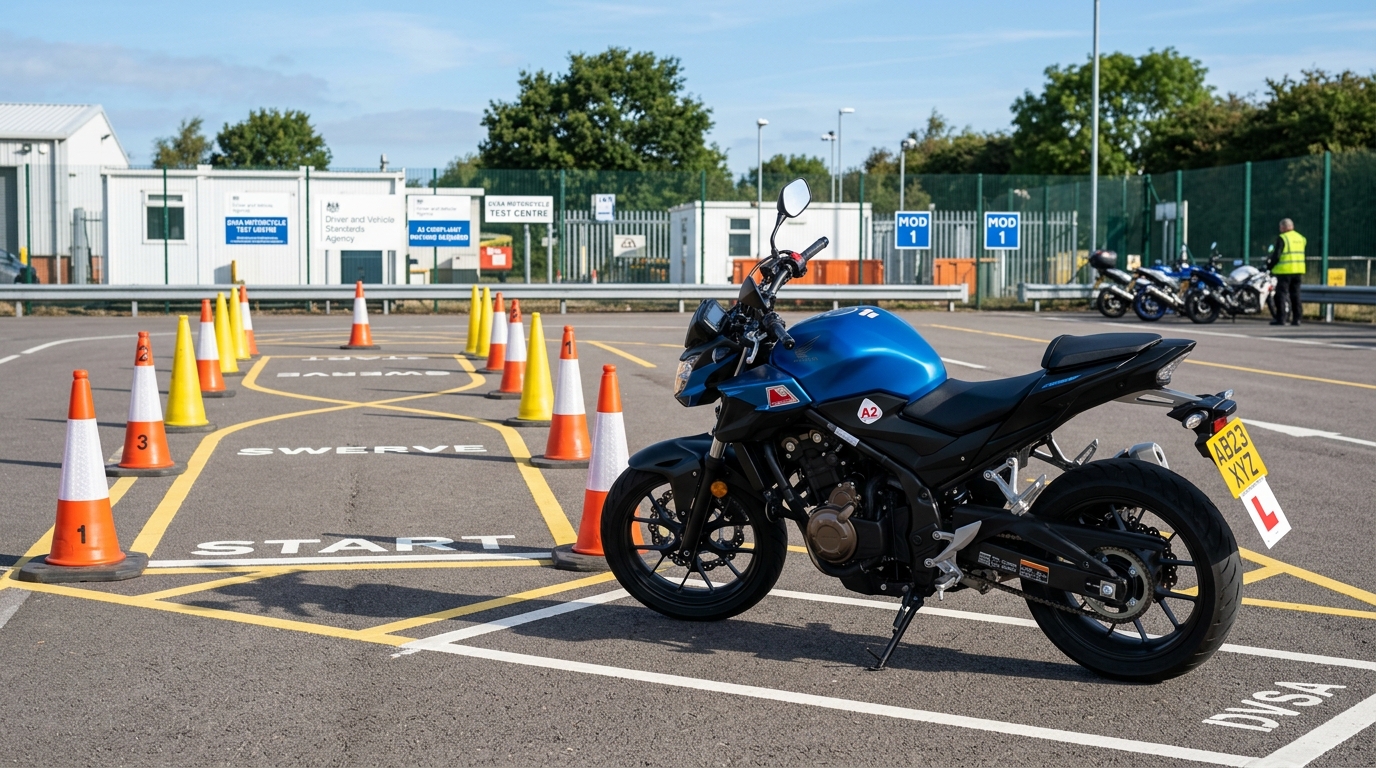
Module 1 (Off-Road Manoeuvres): Conducted on a dedicated tarmac pad at an approved DVSA Multi-Purpose Test Centre (MPTC). The examiner evaluates your machine control through seven distinct exercises: wheeling the bike backwards into a parking bay, riding at walking pace, riding a slalom and figure of eight, executing a controlled slow ride, completing a 180-degree U-turn within painted boundaries, an emergency stop from a minimum speed of 50 km/h (31.5 mph), and a hazard avoidance swerve test from a minimum speed of 50 km/h (31.5 mph). Failing to reach 50 km/h on the speed trap results in an automatic minor or major fault.
Module 2 (Road Riding): Conducted on public roads in mixed traffic conditions. The examiner fits you with an audio receiver and follows on a motorcycle or car. The test begins with a distance eyesight check (reading a number plate at 20 metres) and two motorcycle safety questions ("tell me, show me" safety checks on tyres, brakes, oil, and lights). You then complete roughly 35 minutes of road riding across roundabouts, urban streets, dual carriageways, and rural roads, including an independent riding segment following directional road signs.
You cannot take an A2 test on an arbitrary motorcycle. The bike you use must meet the DVSA minimum test vehicle specifications: minimum engine displacement of 245cc, net power output between 20 kW and 35 kW, and a power-to-weight ratio up to 0.20 kW/kg. Most candidates hire an approved school motorcycle rather than insuring and transporting a private motorcycle to the test centre.
🏍️ 5. How to Get an A2 Motorcycle Licence: Step-by-Step Rider Pathway
Riders wondering how to get an a2 motorcycle licence must understand the step-by-step regulatory progression from provisional entitlement to full licence privileges. The UK licensing system provides two distinct paths to reach an unrestricted category A licence: the Progressive Access Route and the Direct Access Scheme (DAS).
Compulsory Basic Training (CBT) & Theory
Complete a one-day CBT course. This validates your provisional motorcycle entitlement, permitting learner road riding on up to a 125cc (11 kW) motorcycle with L plates. You cannot ride an A2 motorcycle on a CBT certificate alone. Pass your DVSA motorcycle theory test (valid for two years).
Category A2 Practical Test Pass
Complete professional training and pass DVSA Module 1 and Module 2 on a qualifying 20 kW to 35 kW motorcycle. Upon passing, your full A2 licence is issued: you can discard L plates, carry pillion passengers, ride on motorways, and ride any motorcycle up to 35 kW with no engine cc restriction.
Progressive Access to Full Category A
Once you have held your full A2 licence for at least two consecutive years, you become eligible to upgrade to a full, unrestricted Category A licence from age 21. You do not need to retake your CBT or theory test; you only need to pass Module 1 and Module 2 practical tests on an unrestricted motorcycle producing at least 50 kW.
Direct Access Scheme (DAS)
Riders who reach age 24 can bypass the A2 category entirely. By completing CBT, theory, and taking Module 1 and Module 2 directly on an unrestricted 50 kW+ machine, you receive an immediate full Category A licence with zero power or weight limitations.
Make sure your protective equipment meets legal inspection standards before your test day by reading our comprehensive DVSA safety tests and motorcycle helmet guide and checking CE garment ratings.
Sources & further reading
- GOV.UK: Motorcycle licence categories & requirements
- DVSA: Motorcycles you can use for the riding test
- DVSA: Book your practical motorcycle test
- GOV.UK: Compulsory Basic Training (CBT)
- nidirect: Northern Ireland motorcycle licence routes
Specifications, prices and rules can change. Check the linked primary source before making a purchase or riding decision. Our editorial standards.