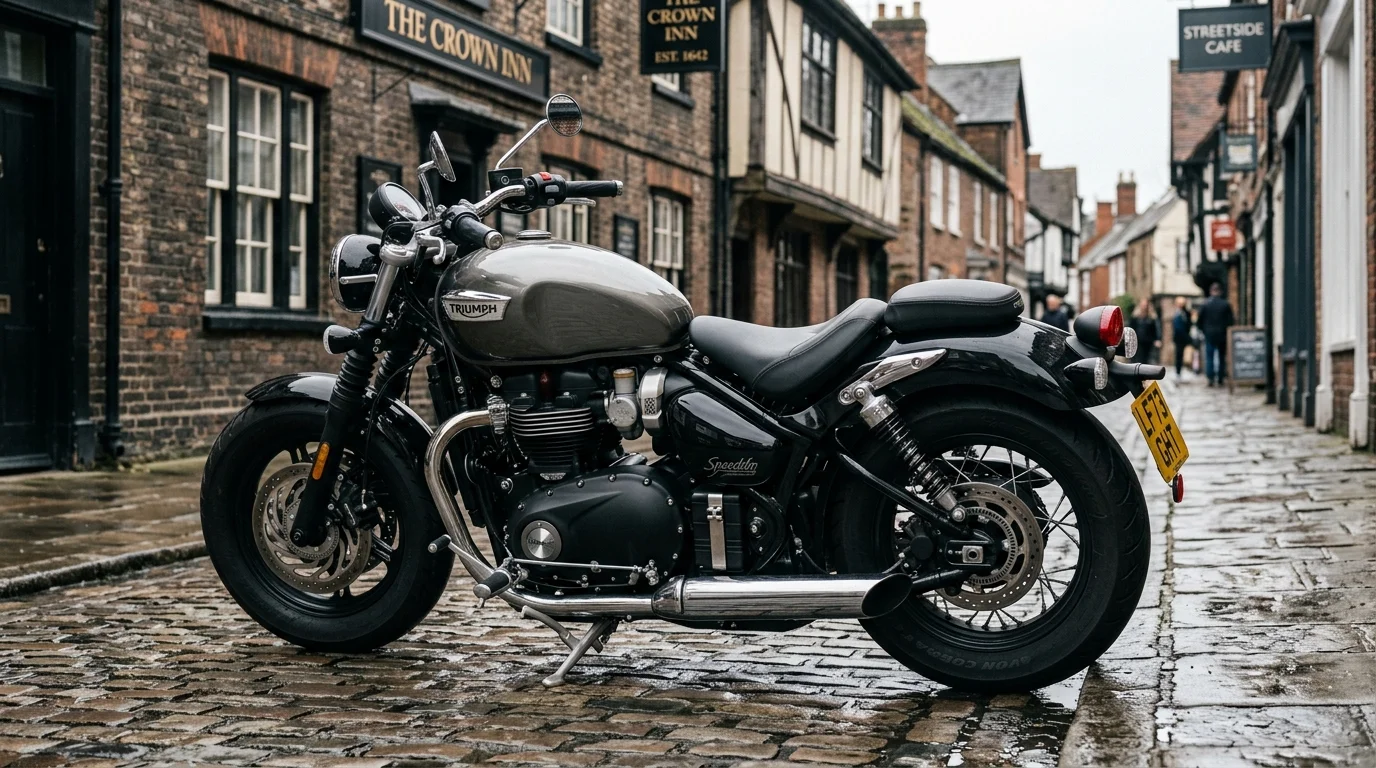
⚡ 1. The Low Seat Illusion: Standover Width vs Nominal Seat Height
When shopping for a first cruiser motorcycle, almost every new rider begins by searching for low seat heights. On paper, figures like 690 mm (Honda Rebel 500) or 705 mm (Harley-Davidson Nightster) appear remarkably accessible compared to a typical 805 mm naked bike or an 830 mm adventure machine. However, judging motorcycle fit by nominal seat height alone is one of the most common mistakes in motorcycle buying.
What determines whether your feet touch the tarmac securely is effective standover width, not vertical seat height. Standover width is the arch measurement your inner thighs and legs must travel over the motorcycle chassis and engine cases.
Engine and Primary Cover Splay
Cruiser engines, particularly V-twins with external primary drives and wide air cleaner assemblies, push your knees and calves outward. A 700 mm seat perched over a 400 mm wide chassis forces your legs into a wide V-shape, robbing you of 30 mm to 50 mm of vertical leg reach.
Saddle Contour & Thigh Taper
Many cruiser seats are sculpted broad and dished to distribute rider weight during highway cruising. If the front nose of the saddle is wide and square, it cuts into your hamstrings when you put your feet down at junctions, forcing you onto your tiptoes. Conversely, a narrow parallel-twin roadster with a 790 mm seat and a slim waistline often allows a rider with a 29-inch inseam to flat-foot both boots with greater stability than a bulky 710 mm cruiser.
Never test a motorcycle's fit while wearing casual trainers. Always wear your actual thick-soled riding boots. Have a member of showroom staff hold the motorcycle perfectly vertical off its side stand, then place both feet flat on the floor. If the inside of your thighs are pressed hard against metal engine casings or wide seat vinyl, you will struggle to support the bike when stopping on an uneven road camber.
Filter and compare saddle widths, kerb weights and inseam measurements across dozens of current road bikes using our interactive Bike Fit Checker.
📐 2. Understanding the Ergonomic Triangle: Seat Height, Bar Reach, and Peg Placement
The riding position of any motorcycle is dictated by the spatial relationship between three contact points: the saddle, the handlebar grips, and the footrests. This geometry is known as the ergonomic triangle. On cruisers, this triangle deviates dramatically from standard upright roadsters, fundamentally altering how your body handles physical forces and machine control.
Forward Controls vs Mid-Mounted Footpegs
Cruiser foot controls generally fall into two distinct configurations:
- Forward Controls: Footpegs and foot levers are mounted far ahead of the engine, placing your legs outstretched with knees slightly bent. While relaxed on smooth, sweeping dual carriageways, forward controls prevent your legs from bearing any body weight. When you strike a sunken drain cover, pothole, or speed table on a UK road, you cannot stand up on the pegs to absorb the shock; every joule of impact energy is driven straight through your seat and up your lower spine.
- Mid-Mounted Controls: Footpegs are placed directly beneath your hips or slightly forward. Mid controls keep your pelvis tilted in a neutral position, allow you to weight the pegs through corners to steer more actively, and give your thighs the leverage needed to lift your rear off the seat over unexpected road bumps. For first-time riders, mid controls deliver substantially better low-speed control.
Handlebar Tiller Effect and Low-Speed Manoeuvring
Cruiser handlebars often feature significant pullback or wide "buckhorn" styling. While comfortable in a straight line, sweeping handlebars can create an awkward tiller effect during tight low-speed turns:
- When turning the steering to full lock (such as during a DVSA Module 1 U-turn or when negotiating a tight mini-roundabout), the outside grip swings far away from your torso while the inside grip pulls into your stomach.
- If your arms are not long enough to maintain full throttle and clutch modulation at full steering lock without leaning your entire torso forward, you risk stalling the machine and dropping it at walking pace.
Cruisers carry their weight low down, which makes them feel light and planted once rolling at 30 mph. But when you need to park, reverse out of a gravel driveway, or back into a bay with a slight upward incline, moving a 220 kg to 260 kg motorcycle purely with your legs while seated in a feet-forward position is physically exhausting. Always evaluate whether you can walk the bike backwards with ease before buying.
💷 3. UK Cruiser Running Costs: VED Road Tax, Insurance & A2 Restriction
Budgeting for a first cruiser requires looking beyond the initial showroom price or monthly finance payment. In the UK, cruisers present unique ongoing financial realities involving government vehicle excise duty (VED), motorcycle insurance groups, and statutory licence power restrictions.
The VED Capacity Trap (2026/27 Rates)
UK motorcycle road tax is calculated strictly on engine displacement (cc), regardless of how much power the engine actually produces:
- Up to 150cc: £27.00 per year
- 151cc to 400cc: £59.00 per year (e.g. Royal Enfield Meteor 350)
- 401cc to 600cc: £90.00 per year (e.g. Honda Rebel 500, Kawasaki Eliminator 500)
- Over 600cc: £125.00 per year (e.g. Triumph Bonneville Speedmaster 1200, Harley-Davidson Nightster 975)
Many traditional cruiser engines are tuned for low-revving torque rather than peak horsepower. A 1200cc cruiser may only make 75 bhp, yet it sits in the highest £125/year tax band alongside 200 bhp superbikes. Calculate your exact yearly road tax and fuel spend using our UK Motorcycle Running Costs & VED Estimator.
A2 Licence Compliance and Restrictor Kits
If you hold a UK A2 motorcycle licence, your machine must not exceed 35 kW (46.9 bhp), must not exceed 0.20 kW per kg, and must not be derived from a motorcycle producing more than double its restricted power (maximum 70 kW / 94 bhp original output):
- Native A2 Cruisers: Models like the Royal Enfield Meteor 350 (14.9 kW) and Honda Rebel 500 (34 kW) are manufactured fully compliant from the factory, requiring no restrictor hardware or paperwork.
- Restricted Middleweights: Machines like the Harley-Davidson Nightster 975 produce 66 kW in standard trim (comfortably below the 70 kW ceiling) and can be legally restricted to 35 kW for A2 riders. However, you must obtain an official certificate of restriction and declare the modification to your insurer.
- Ineligible Cruisers: Older heavyweight cruisers producing more than 70 kW cannot legally be restricted for an A2 licence under any circumstances. Verify whether restrictor kits meet DVSA guidelines with the Licence & A2 Eligibility Tool, and review the full statutory rules in our UK A2 licence guide.
🔍 4. A Calm, Repeatable Used Cruiser Inspection Checklist
Buying a used cruiser in the UK requires a methodical mechanical assessment. Cruisers are frequently customized by previous owners and often suffer from specific corrosion issues caused by British winter road salt and rain.
Cruiser-Specific Mechanical Inspection Points
- Belt Drive Condition: Many modern cruisers (Harley-Davidson, Indian, high-end Triumphs) use a carbon-reinforced toothed belt drive instead of a chain. Inspect the belt carefully with a torch: look for stone punctures in the centre of the belt, frayed cords along the edges, or stripped teeth. Replacing a final drive belt and rear pulley can easily cost £350 to £600 in parts and labour.
- Steering Head Bearings: Cruisers feature raked-out front forks (often 28 to 34 degrees of rake), which place heavy axial leverage onto the steering headstock bearings. With the bike on a central paddock stand or jack, turn the bars slowly from lock to lock: any notchiness, binding, or play in the headstock indicates worn bearings requiring immediate replacement.
- Exhaust Flanges & Chrome Corrosion: Examine the cylinder head exhaust studs and lower frame rails. British road salt quickly pits lower exhaust chrome and causes severe rust on mild-steel exhaust collector boxes hidden underneath the frame.
- Aftermarket Controls & Wiring: Cruisers are heavily customized with aftermarket high-rise handlebars ("ape hangers") and forward foot control extension kits. Inspect the control wiring and brake lines: ensure brake hoses were replaced with extended, pressure-certified braided lines rather than strained stock hoses, and check that switchgear wiring was soldered and heat-shrinked properly rather than twisted and taped.
- Official Documentation: Always cross-reference the stamped frame VIN number with the V5C logbook, check the MOT history on GOV.UK for structural corrosion advisories, and verify outstanding finance before exchanging cash.
🏆 5. Best Beginner Cruisers Compared: Seat Height, Wet Weight & Power
To choose your ideal first cruiser, compare realistic ownership trade-offs across lightweight singles, manageable twins, and full-fat middleweights rather than looking at badge appeal alone.
| MOTORCYCLE MODEL | SEAT HEIGHT | WET / RUNNING WEIGHT | POWER / A2 COMPLIANT | UK VED BAND | SEGMENT VERDICT |
|---|---|---|---|---|---|
| Royal Enfield Meteor 350349cc Air-Oil Single · Mid-Pegs | 765 mm | 191 kg | 20.2 bhp (Native A2) | Band 2 (£59/yr) | 🏆 Best Accessible Cruiser |
| Honda Rebel 500 (CMX500)471cc Parallel Twin · Neutral Pegs | 690 mm | 191 kg | 46.9 bhp (Native A2) | Band 3 (£90/yr) | 🏆 Best Lightweight Daily |
| Kawasaki Eliminator 500451cc Parallel Twin · Mid-Pegs | 735 mm | 176 kg | 44.8 bhp (Native A2) | Band 3 (£90/yr) | 🏆 Best Agile Commuter |
| Harley-Davidson Nightster 975975cc Revolution Max V-Twin · Mid-Pegs | 705 mm | 221 kg | 89.0 bhp (A2 Restrictable) | Band 4 (£125/yr) | 🏆 Best Modern Performance |
| Triumph Speedmaster 12001200cc High-Torque Twin · Forward Pegs | 705 mm | 263 kg | 76.9 bhp (Full A Licence Only) | Band 4 (£125/yr) | 🏆 Best Heavyweight Tourer |
Combine your machine choice with proper rider protection: read our complete guides to motorcycle helmet safety standards and CE garment ratings before taking delivery.
❓ 6. Frequently Asked Questions: First Cruiser Buying & Ownership
Is a cruiser good for a first motorcycle?
Yes, provided you choose a lightweight or middleweight model (under 200 kg) with mid-mounted foot controls, such as a Honda Rebel 500, Kawasaki Eliminator 500, or Royal Enfield Meteor 350. Cruisers offer a confidence-inspiring low centre-of-gravity and an easy reach to the ground for nervous riders. However, heavy cruisers (over 230 kg) and machines with extreme forward foot controls can make low-speed slow riding, U-turns, and manual parking significantly more difficult for novices.
Can I ride a cruiser on an A2 motorcycle licence?
Yes. Many popular cruisers are factory-compliant with the UK A2 licence limit of 35 kW (46.9 bhp) and 0.20 kW/kg, including the Honda Rebel 500, Royal Enfield Super Meteor 650, and Kawasaki Eliminator. Larger machines producing up to 70 kW in original trim (such as the Harley-Davidson Nightster 975 or Street 750) can be legally restricted to 35 kW using an approved restrictor kit. Cruisers producing over 70 kW originally cannot legally be restricted for A2 licence holders.
Why does a low seat height bike feel heavy to paddle backwards?
A low seat height bike feels heavy to paddle backwards because low-slung cruisers often carry substantial kerb weights (200 kg to 260 kg) paired with feet-forward seating ergonomics. In a feet-forward riding position, your legs are pushed out ahead of your hips, which drastically reduces your mechanical hamstring leverage. Backing the bike up a gravel drive or across a road camber requires far more physical effort than paddling an upright, lighter commuter motorcycle.
Are forward controls bad for your back on UK roads?
Forward controls can cause lower back fatigue on poorly maintained UK roads because they force your pelvis into a rearward tilt while placing your feet far ahead. In this seated posture, you cannot push down on the footpegs to raise your body over potholes, railway crossings, or sunken road maintenance covers. Consequently, 100% of the shock transmitted through the rear suspension travels directly into your lumbar spine and tailbone.
Sources & further reading
- Manufacturer specifications & geometry data
- GOV.UK: Check vehicle MOT history and mileage
- DVSA: Approved motorcycles for test and licence categories
Specifications, prices and rules can change. Check the linked primary source before making a purchase or riding decision. Our editorial standards.